Developing healthcare software has become faster, smarter, and more AI-driven in 2026. With the rapid adoption of telemedicine, AI-powered diagnostics, wearable healthcare devices, and cloud-based electronic health records, healthcare software is now one of the fastest-growing sectors in the global tech industry.
According to recent healthcare IT reports, the global healthcare software market is expected to surpass $900 billion by 2030, driven by increasing investments in digital healthcare infrastructure, remote patient monitoring, and AI automation.
In this guide, we’ll explore the latest healthcare software trends, development process, essential features, security standards, and future opportunities in 2026.
What is Healthcare Software?
Healthcare software is used to improve patient care through IT systems. This can include EMR or EHR (electronic health records), PHR, and various software, which substantially increase diagnosis accuracy.
It’s a tool of information sharing between medical professionals to give their patients the best possible experience. You may find the terms such as “healthcare ” and “medical software” used interchangeably many times. However, they cover related but different domains.
In essence, healthcare software development covers various activities directed at solving the problems within organisations in the healthcare domain and the relations between healthcare professionals and patients.
The industry involves clinical services, hospitals, medical equipment providers, financing for medicine, and R&D centers. Software development for healthcare systems establishes an ecosystem where healthcare services gain higher quality and accuracy.
Why should you build Healthcare Software?
Medical software is the leading technology for digital transformation in healthcare among virtual reality solutions, wearable medical devices, or on-demand healthcare.
In 2026, healthcare organizations are heavily investing in digital transformation to improve patient experience, reduce operational costs, and automate hospital workflows. AI-powered healthcare systems now assist doctors in diagnostics, treatment recommendations, patient monitoring, and predictive analytics.
There is a rising demand for software development in the industry. The percentage of medical practitioners and patient engagement software is also constantly growing. The medical system is more personalised thanks to digital solutions, allowing continuous care at any place and time.
The main objective of such applications is to create a customer-centered digital healthcare ecosystem. Creating a scalable information space that can be used in clinical institutions and regional networks is necessary.
These systems connect patients, medical consultants, and healthcare providers, which benefits all stakeholders. Apart from this, healthcare software brings benefits like
Benefits for doctors and health organisations
- It does away with the daily paperwork.
- It facilitates seamlessly manage all processes in hospitals
- It provides communication tools for health organisations
- It significantly reduces costs by automating processes
- It improves diagnostics and the quality of medical services
Benefits for patients
- AI-assisted diagnostics and patient monitoring
- Real-time wearable health tracking
- Remote healthcare accessibility
- Predictive analytics for disease prevention
- Faster insurance claim processing
- Improved patient engagement through mobile apps
The benefits mentioned above prove that medical companies should dive into healthcare software development to succeed in the market.
Types of Medical Software
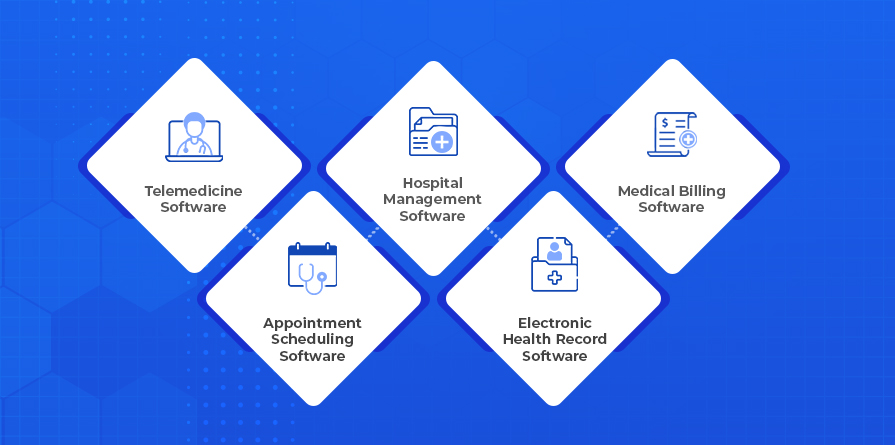
There is no standard or universal medical software type. Each case is different and serves different purposes. We can distinguish the following types of medical software
1. Hospital Management Software
Hospital management software can manage the overall activities of any healthcare organisation and assist in operating several administrative tasks such as doctor management, patient management, bed management, and so on.
So, it can help to reduce the workload and provide an organised system for your medical organisation. Features of Hospital Management Software are
- Provides an effective financial management
- Incorporated with OPD & IPD system
- Appointment handling system
- Smooth billing and prescription system
- Human resource management system, and more.
2. Medical Billing Software
If you have required to conduct only the billing activities of your healthcare organisation, you can integrate the Medical billing software. It can be able to conduct the entire billing process as well as ensure secure transactions. So, you can easily keep track of all transactions, patient invoices, and so on. Features of Healthcare Billing Software are
- Provides appointment management system
- Allows medical claim management
- Credit card payment system
- Generate an accurate report
- Provides patient information, and so on.
3. Electronic Health Record Software
Electronic health record software allows the users to keep a record of all essential information. Also, it can provide the facilities to store patient information, medical charts, clinical data, and so on.
Moreover, the EHR software allows the operator to access the centralised database easily, and the operators can retrieve any data they want. Features of Electronic Health Record Software are
- Integrate with AI-based tools
- Effective IT management system
- Task management system
- Provides smart analytics tools
- Integrated with a centralised database and more
4. Appointment Scheduling Software
The most crucial thing for any healthcare organisation is to manage the appointment system, and you can take this advantage through appointment scheduling software.
The appointment scheduling software allows the operator to take online appointments and keep a record. So, it can save time for both patients and operators and build a more convenient system for the patients. Features of Appointment Scheduling Software are
- Auto reminder system
- SMS and email notification system
- Appointment handling process
- Calendar management system
- Doctor management system, and more.
5. Telemedicine Software
Telemedicine software is another significant type of healthcare software that can provide the opportunity to consult with the doctor via the internet.
This software allows the doctor to prescribe the medicine after observing the patient through video conference. So, you can choose this type of healthcare software because it will be more convenient for the patient in case of any emergency. Features of Telemedicine Software are
- Provides e-prescription system
- Allows electronic health record system
- Build-in chatbot system
- Smooth billing system
- Support multiple payment gateways and so on.
These are the core types of healthcare software that will need to modernize your healthcare organisation. So, you can grab your required one.
6. AI-Powered Healthcare Software
AI healthcare software has become one of the most demanded healthcare solutions in 2026. These systems help hospitals and clinics automate diagnostics, analyze patient records, detect diseases early, and improve treatment accuracy.
Features
- AI-based symptom checker
- Predictive analytics
- Medical image analysis
- Smart patient recommendations
- Voice-enabled virtual assistants
7. Remote Patient Monitoring Software
Remote patient monitoring software allows healthcare providers to monitor patients in real time using wearable devices and IoT-enabled healthcare systems.
Features
- Real-time health tracking
- Heart rate and oxygen monitoring
- Emergency alerts
- Cloud data synchronization
- Mobile health dashboards
Step-by-Step Guide to Healthcare Software Development in 2026
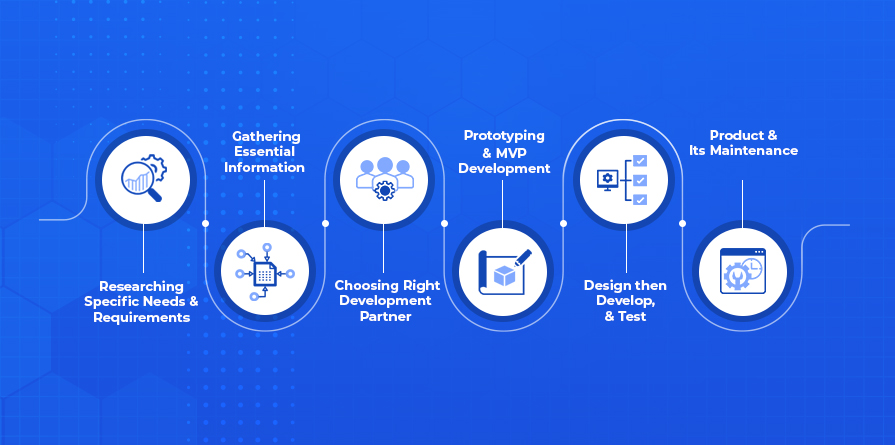
It’s challenging to develop a healthcare web or mobile app without a grasp of the application’s functionalities, features, and goals. Healthcare software development is a lengthy procedure that specialists must carry out. In the general development process, the following steps are included
1. Researching specific needs & requirements
Before you begin developing your healthcare product, make sure to know the needs of your target audience. Research for this goes beyond simply conducting a market analysis, though it can be part of the list.
You need to figure out what your product will be used for or simply the problem it seeks to solve, your potential users’ reviews about it, and how it will be used.
Understanding the demands of customers is a crucial aspect of any industry. Having an idea of the issues they have with the current solution and how it can improve.
Define the user persona and their demand to proceed with your solution as accurately as possible. It might also be beneficial for selecting a sector in which to launch your app.
2. Gathering essential information about your product idea
After getting a grasp of the market, you need to outline the requirements for your product. Another crucial aspect is deciding whether your application will be delivered on a mobile device (iOS, Android, or the web).
A strategic digital transformation plan must specify not only what it intends to resolve and for whom but also the technology best suited for that. It’s essential to understand if your solution is technologically sound. Once you get that, make sure it’s also financially sound.
3. Choosing the right development partner
Getting professional healthcare software development services will guarantee that your app has all of the latest functionality and uses proper technology and features at a low cost. Your app development partner will further research various stack technologies to get the best one for you.
4. Prototyping & MVP development
A prototype is a kind of interactive mock-up of your product. It’s not a complete solution but a base for it. Prototyping is essential for various reasons
- It’s a great way to test a product before building it.
- You can gather feedback and ensure you’re going in the right direction before investing too much money, time, and effort in development.
- You diminish the risk of failure & adjust your project while working on it rather than in the end when it will be more expensive to fix mistakes.
Another option to get validation is an MVP.. It’s a simplified final product version that covers just the most critical functionality. It’s an excellent tool to see if your concept is exciting and should be explored further or if it can benefit from some pivots to the underlying assumptions.
5. Design then develop, and test
One of the most crucial stages of healthcare software development is design. You should never forget that the user interface is where patients and doctors will interact with your software, so you must ensure that this experience is easy and seamless.
Another critical process when developing healthcare solutions is testing. Everything should be tested by quality assurance (QA). It will assist in reducing development expenses & other resources, identifying various issues, and building your reputation as a healthcare organization.
6. The release of the product and its maintenance
This is the time to invite your customers after the application is ready. Keep in mind that there are still some post-development steps left.
You must keep your application up-to-date if you want it to be a success in the long run. This implies regularly implementing bug fixes, updating the application to reflect new regulations, and constantly improving its security and performance.
7. AI Integration & Compliance Testing
In 2026, healthcare software must support AI capabilities, cloud scalability, cybersecurity protocols, and strict healthcare compliance standards such as HIPAA, GDPR, HL7, and FHIR. Comprehensive testing ensures data privacy, interoperability, and seamless performance across devices.
Future Scope of Software Development in Healthcare
2020 demonstrated how helpless the world could be when facing a pandemic. It has shown that healthcare systems in even developed countries need to be transformed. This transformation is impossible without the state of the art technology, as the challenges are massive.
Healthcare is currently undergoing a digital revolution like all other domains.
In 2026, Artificial Intelligence, Machine Learning, blockchain, cloud computing, and IoT are already transforming the healthcare industry. AI-powered virtual healthcare assistants, robotic surgeries, predictive healthcare analytics, and digital twins are becoming mainstream in modern healthcare systems.
The healthcare industry is also witnessing rapid growth in:
- Generative AI in healthcare
- AI-powered diagnostics
- Remote patient monitoring
- Healthcare cybersecurity
- Smart wearable devices
- Personalized medicine platforms
- Blockchain-based medical records
Experts predict that AI alone could save the healthcare industry billions annually through automation and early disease detection.
Famous Examples of Healthcare Software Development
1. Teladoc Health
One of the world’s leading telemedicine platforms offering virtual consultations, remote care, and AI-powered patient engagement services.
2. Fitbit by Google
Fitbit continues to dominate wearable healthcare tracking with AI-driven wellness insights, sleep tracking, heart monitoring, and fitness analytics.
3. MyChart
A leading patient portal solution allowing users to access medical records, schedule appointments, and communicate with healthcare providers securely.
4. Ada Health
An AI-powered healthcare assistant that helps users identify symptoms and get personalized healthcare guidance.
5. Medscape
Still one of the most trusted platforms for healthcare professionals, offering medical news, clinical tools, and drug references.
Considerations for Healthcare Software Development
In 2026, cybersecurity has become one of the biggest concerns in healthcare software development. Healthcare companies must implement advanced security practices such as zero-trust architecture, end-to-end encryption, multi-factor authentication, and AI-powered threat detection systems to protect sensitive patient data.
Vendor selection is a complicated and lengthy process, and a wrong choice can ruin the whole project for you. Here are a few crucial things you should look for in a software outsourcing company
1. Security Measures
To provide adequate healthcare software solutions, you must deal with vast volumes of sensitive information. Hence, ensure your future outsourcing partner builds a healthcare app with robust security practices and complies with international security regulations like HIPAA, PCI, and ISO.
2. Technological Expertise
If you have chosen the appropriate tech stack for your healthcare app, ensure that the company has relevant competencies. For instance, a clinical software development company must have sufficient expertise in embedded software development.
3. Scalability and Capacity
Try to hire large or mid-size development firms as, in all likelihood, they are quite experienced in handling large-scale projects with better capacity, tools, and processes. Based on your software project requirements, they should provide you with ample resources and a sizeable team.
4. Industry Knowledge
The development company must have profound domain expertise to build a successful healthcare app. Look for similar projects that they have worked on in the past.
5. Experienced Developers
A healthcare app is a multi-tiered software with varied technologies and complex architecture. Hence, your healthcare software development company must have experienced developers who can work on your project.
Conclusion!
Healthcare software development in 2026 is no longer limited to digital record management. Modern healthcare applications are powered by Artificial Intelligence, cloud computing, IoT, and advanced analytics that improve patient care, streamline hospital operations, and enhance medical decision-making.
As the demand for telemedicine, wearable healthcare apps, AI diagnostics, and remote patient monitoring continues to grow, businesses investing in healthcare software solutions today are positioning themselves for long-term success.
Choosing the right healthcare software development partner is essential for building secure, scalable, and future-ready healthcare applications.
At Rudra Innovative Software, we help healthcare businesses develop custom healthcare software solutions tailored for modern patient and hospital needs.