In today’s digital-first world, applications are the backbone of customer engagement, operational efficiency, and business growth. From booking a cab and ordering food to managing enterprise workflows, apps have become an inseparable part of how users interact with brands. Understanding Web Apps vs Native Apps vs Hybrid Apps helps organizations evaluate cost, performance, scalability, and user experience before investing in development.
However, when businesses plan to build an application, one fundamental question arises early in the decision-making process:
Should we build a web app, a native app, or a hybrid app?
Each application type comes with its own advantages, limitations, development approach, and cost implications. Choosing the wrong type can result in poor performance, low adoption, higher maintenance costs, or delayed time to market.
This comprehensive guide explains web apps, native apps, and hybrid apps, their differences, use cases, costs, performance, and how businesses can decide the right approach for their product in 2026 and beyond.
What Is an Application?
An application is a software solution designed to perform specific tasks, automate processes, or deliver services to users. Applications are typically built using modern software development practices and deployed across browsers, desktops, or mobile devices.
- How they are developed
- Where they run
- How users access them
- How deeply they integrate with device hardware and operating systems
Based on these factors, modern apps are generally categorized into:
- Web Applications
- Native Applications
- Hybrid Applications
Why Do Different Types of Applications Exist?
To understand why these app types exist, it helps to look at how application development has evolved over time.
Early Client–Server Applications
In the early days of computing, applications were installed directly on individual machines or company networks. Most systems followed a client-server architecture, where:
- Data was stored and processed on centralized servers
- Users installed client software on their devices
- Separate versions were required for Windows, Linux, or macOS
This made development expensive and maintenance complex, especially for organizations with multiple platforms.
The Rise of Web Applications
As the internet matured, web browsers became powerful enough to deliver application-like experiences. Businesses no longer needed users to install software manually. Instead:
- Users accessed applications directly through a browser
- Updates were deployed centrally
- Applications became accessible globally
This led to the rapid adoption of web applications.
The Mobile App Revolution
The introduction of smartphones created entirely new platforms like Android and iOS. Users began expecting fast, responsive, and immersive experiences optimized for mobile devices. This demand gave rise to native mobile apps.
To bridge the gap between web simplicity and native performance, hybrid apps emerged as a middle ground.
What Is a Web Application?
A web application is software that runs in a web browser. Users do not need to download or install anything. They simply visit a URL and start using the app.
Examples include:
- Gmail
- Google Docs
- Online banking portals
- CRM dashboards accessed via browsers
How Web Apps Work
Web apps typically follow this structure:
- Frontend runs inside the browser (HTML, CSS, JavaScript)
- Backend runs on remote servers
- Data is stored in cloud or server-side databases
- Communication happens over the internet via APIs
Advantages of Web Applications
1. Easy Accessibility – Users can access web apps from any device with a browser and internet connection.
2. Faster Development & Deployment – A single codebase serves all platforms, reducing development time.
3. Cost-Effective – Web apps are generally cheaper to build and maintain than mobile apps.
4. Instant Updates – New features and bug fixes are instantly available to all users.
Web apps are often paired with digital marketing services to increase reach and online visibility.
Limitations of Web Applications
1. Limited Access to Device Features
Web apps have restricted access to hardware such as cameras, sensors, and biometric authentication.
2. Browser Dependency
User experience and performance can vary across browsers.
3. Internet Dependency
Most web apps require a stable internet connection to function properly.
What Is a Native Applications?
A native app is developed specifically for a particular platform or operating system, such as:
Users download native apps directly from app stores like Google Play or Apple App Store.
How Native Apps Work
Native apps:
- Are compiled for a specific platform
- Run directly on the device’s operating system
- Have full access to device hardware and APIs
- Deliver high performance and responsiveness
Advantages of Native Applications
1. Superior Performance – Native apps are fast, responsive, and optimized for the device.
2. Full Access to Device Features – They can use GPS, camera, microphone, biometrics, sensors, and offline storage.
3. Best User Experience – Native UI components provide consistent and intuitive interactions.
4. Offline Capabilities – Many native apps work even without an internet connection.
Limitations of Native Applications
1. Higher Development Cost – Separate apps must be built for Android and iOS.
2. Longer Time to Market – Development, testing, and approvals take more time.
3. Ongoing Maintenance Effort – Updates must be released separately for each platform.
What Is a Hybrid Applications?
A hybrid app is a native application that internally runs web content. It combines elements of both web and native apps. Users install hybrid apps from app stores, just like native apps, but much of the app’s logic is built using web technologies.
Popular hybrid frameworks include:
- React Native
- Ionic
- Apache Cordova
- Flutter
How Hybrid Apps Work
Hybrid apps use:
- A single web-based codebase (HTML, CSS, JavaScript)
- A native container that allows access to device features
- Plugins or APIs to interact with hardware
Advantages of Hybrid Applications
1. Single Codebase – One app can run across multiple platforms.
2. Lower Development Cost – Reduced engineering effort compared to native apps.
3. Faster Time to Market – Quicker launches across Android and iOS.
4. App Store Presence – Hybrid apps are distributed through app stores, increasing discoverability.
Limitations of Hybrid Applications
1. Performance Trade-Offs – Hybrid apps may not match the speed of fully native apps for complex tasks.
2. Dependency on Frameworks – Performance and compatibility depend on the hybrid framework used.
3. UI Limitations – Highly customized UI animations can be challenging.
Progressive Web Apps (PWAs): Where Do They Fit?
Progressive Web Apps (PWAs) are advanced web apps that offer native-like features such as:
- Offline access
- Push notifications
- Home screen installation
How PWAs Differ from Hybrid Apps
- PWAs run entirely in the browser
- No app store installation required
- Better SEO and organic discoverability
- Lighter in size compared to hybrid apps
However, PWAs still have limited access to advanced native features, especially on iOS.
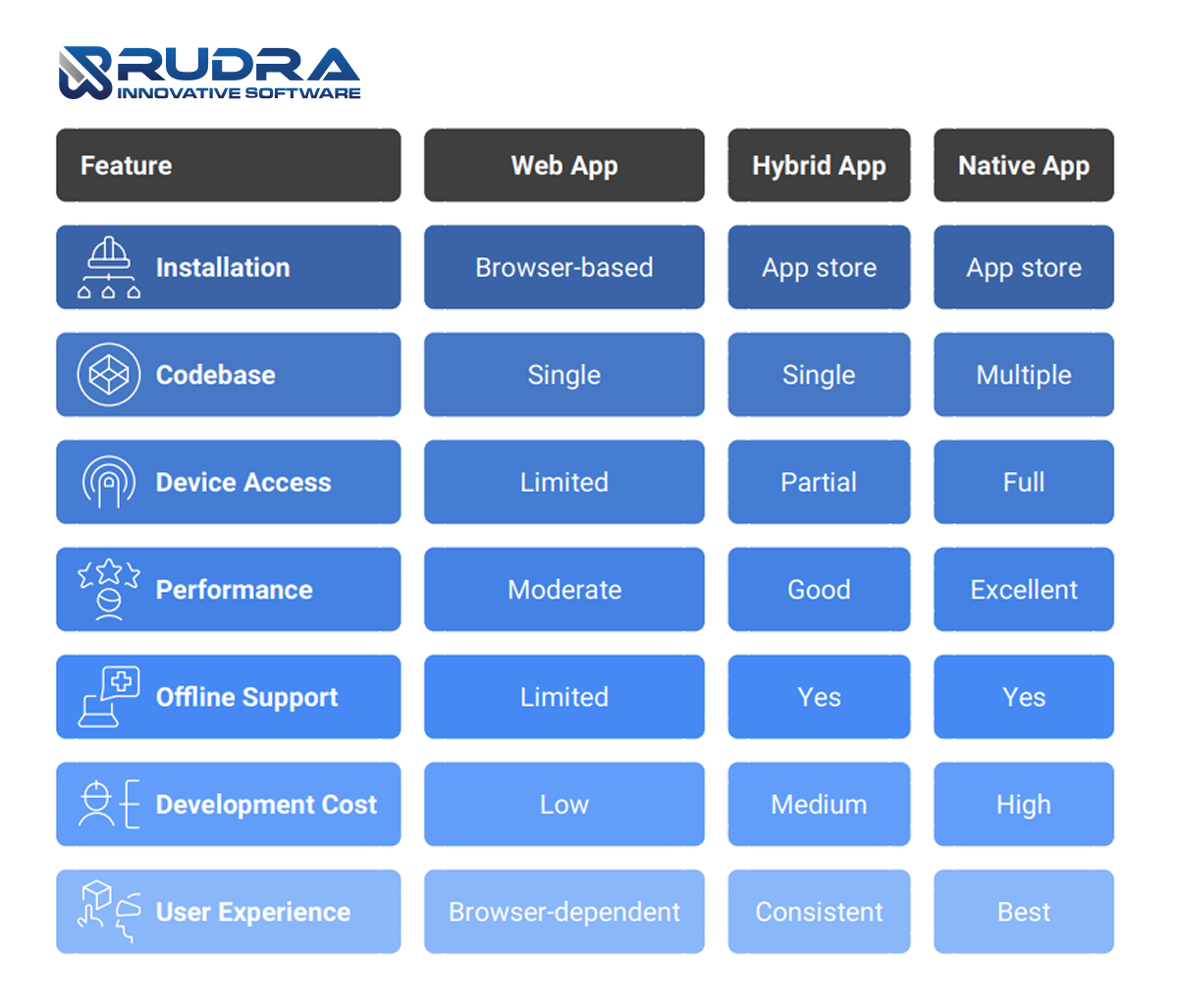
Key Differences: Web Apps vs Native Apps vs Hybrid Apps
A clear comparison of Web Apps vs Native Apps vs Hybrid Apps reveals that each application type serves a different purpose, making the choice dependent on business goals, target audience, and technical complexity.
 When Should You Choose Each App Type?
Choose a Web App When:
- You need fast deployment
- Budget is limited
- SEO and discoverability matter
- The app is content-heavy or admin-focused
Choose a Native App When:
- Performance is critical
- The app relies heavily on device hardware
- You want the best possible UX
- Security requirements are high (e.g., banking apps)
Choose a Hybrid App When:
-
-
- You want app store presence with lower cost
- Time to market is a priority
- You need moderate access to device features
- Your product roadmap spans multiple platforms
-
App Development Challenges for Businesses
Modern businesses face challenges such as:
-
-
- Supporting multiple platforms
- Managing separate codebases
- High maintenance costs
- Slower feature rollouts
-
Architectural approaches like microservices, containerization, and serverless computing help address these issues and improve scalability.
How Rudra Innovative Supports Modern App Development
At Rudra Innovative, we help businesses design, build, and scale high-performance web, native, and hybrid applications using modern cloud-first architectures. Our development approach focuses on flexibility, scalability, security, and faster time-to-market—without burdening clients with complex infrastructure management.
By leveraging industry-leading cloud platforms and proven development frameworks, we ensure that applications are reliable, future-ready, and capable of supporting business growth at every stage.
Our Cloud-Driven App Development Capabilities
-
-
- End-to-End App Development – We build full-stack web and mobile applications, handling everything from UI/UX design and frontend development to backend logic and cloud deployment.
- Serverless & Scalable Backends – Our team designs serverless and microservices-based architectures that automatically scale with user demand, reducing operational overhead and infrastructure costs.
- Continuous Deployment & Hosting – We implement CI/CD pipelines to enable seamless updates, faster releases, and minimal downtime for web and mobile applications.
- Secure API Development & Integration – Rudra Innovative develops and manages secure APIs that enable smooth communication between applications, third-party services, and enterprise systems.
- Cloud-Optimized Databases – We work with both relational and NoSQL databases to ensure high availability, data security, and optimal performance for applications of any scale.
-
Why Choose Rudra Innovative for App Development?
-
-
- Faster development cycles with modern cloud technologies
- Scalable architectures that grow with your business
- Reduced infrastructure and maintenance costs
- Secure, high-performance applications built for real-world usage
-
Whether you are launching a new product, modernizing an existing application, or expanding across platforms, Rudra Innovative provides the technical expertise and strategic guidance needed to turn ideas into successful digital solutions.
Final Thoughts
There is no one-size-fits-all approach when it comes to application development. The right choice between web apps, native apps, and hybrid apps depends on your business goals, budget, timeline, and customer expectations.
Many successful companies use a combination of all three to maximize reach and deliver the best user experience across platforms.
By understanding the strengths and limitations of each app type, businesses can make informed decisions and build applications that are scalable, secure, and future-ready.