Enterprise software development has become the backbone of modern business operations, enabling organizations to streamline processes, enhance productivity, and maintain competitive advantages in an increasingly digital marketplace. This comprehensive guide explores everything you need to know about enterprise software development, from fundamental concepts to emerging trends shaping the industry.
What is Enterprise Software Development?
Enterprise software development refers to the creation of large-scale applications designed to meet the complex needs of organizations rather than individual users. These sophisticated systems integrate multiple business functions, support thousands of users simultaneously, and handle massive volumes of data while maintaining security, reliability, and performance.
Unlike consumer-focused applications, enterprise software prioritizes scalability, data integrity, seamless integration with existing systems, and robust security measures. These applications serve as mission-critical infrastructure that organizations depend on for daily operations, strategic decision-making, and long-term growth.
Key characteristics of enterprise software include:
- Multi-user support with role-based access control
- Integration capabilities with legacy and third-party systems
- Advanced security and compliance features
- Scalability to accommodate organizational growth
- Customization options for specific business requirements
- Comprehensive reporting and analytics capabilities
Revenue of the Enterprise Software Market
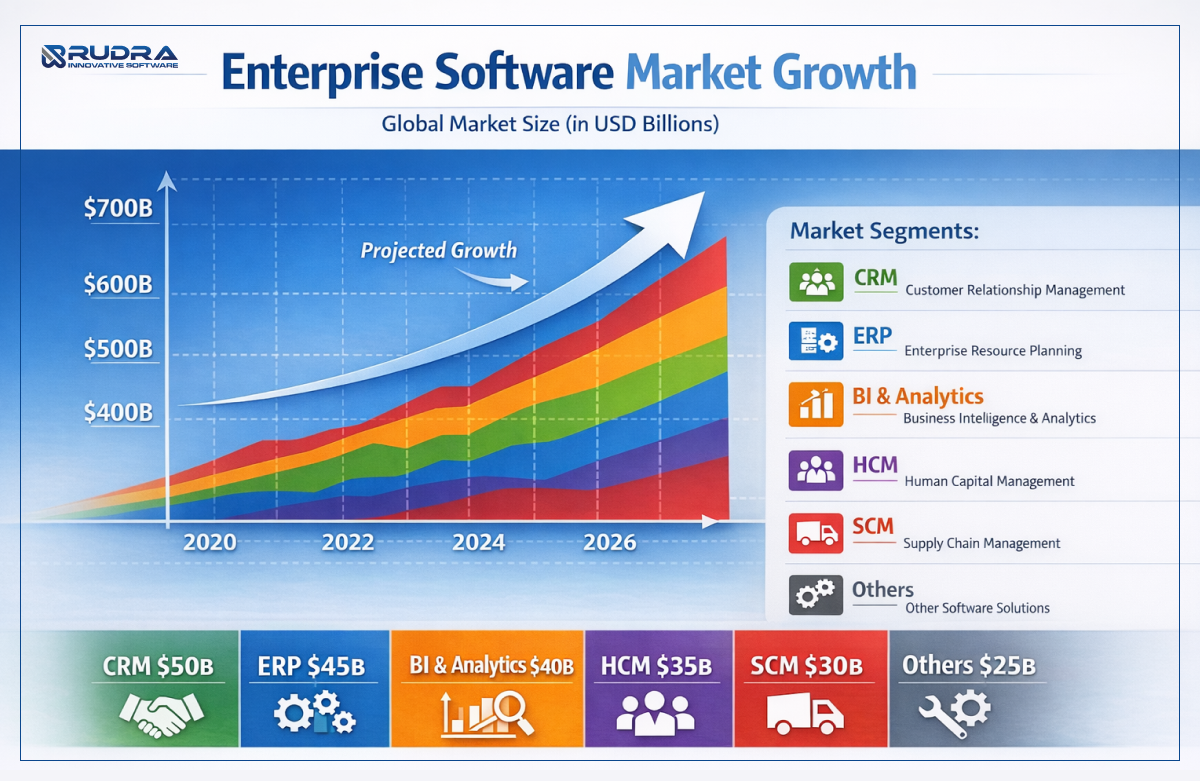
The enterprise software market continues to experience remarkable growth, driven by digital transformation initiatives and increasing cloud adoption across industries.
Market Overview (2024-2026):
| Metric | Value |
|---|---|
| Global Market Size (2024) | $273 billion |
| Projected Market Size (2026) | $315 billion |
| Annual Growth Rate (CAGR) | 7.4% |
| Cloud-based Solutions Share | 68% |
| Fastest Growing Segment | AI-powered Enterprise Tools |
The market expansion reflects organizations’ recognition that modern enterprise software is no longer optional but essential for survival in competitive markets. Industries such as healthcare, finance, manufacturing, and retail are leading adopters, investing heavily in digital infrastructure to improve operational efficiency and customer experiences.
Enterprise Software Development Models
Organizations can choose from several development models based on their specific requirements, budget constraints, and strategic objectives.
1. Custom Development
Building software from scratch tailored to unique business requirements. This approach offers maximum flexibility and competitive differentiation but requires significant time and investment.
2. Commercial Off-the-Shelf (COTS)
Purchasing pre-built software solutions that can be configured to meet business needs. This model reduces development time and costs but may limit customization options.
3. Hybrid Approach
Combining COTS solutions with custom-developed components to balance cost-effectiveness with specific functionality requirements.
4. Low-Code/No-Code Platforms
Leveraging visual development environments that enable faster deployment with minimal coding. Increasingly popular for rapid prototyping and departmental applications.
5. Open Source Solutions
Utilizing community-developed software that can be customized and extended. Offers cost advantages but requires technical expertise for implementation and maintenance.
Top 5 Types of Enterprise Software
CRM (Customer Relationship Management)
CRM systems centralize customer data, interactions, and touchpoints across the entire customer lifecycle. These platforms enable sales teams to track leads, marketing departments to run targeted campaigns, and customer service representatives to provide personalized support.
Key features include: contact management, sales pipeline tracking, marketing automation, customer service ticketing, analytics and reporting, and mobile accessibility.
Leading CRM platforms like Salesforce, Microsoft Dynamics 365, and HubSpot have transformed how organizations build and maintain customer relationships, with businesses reporting up to 29% increase in sales productivity after CRM implementation.
ERP (Enterprise Resource Planning)
ERP systems integrate core business processes including finance, human resources, manufacturing, supply chain, and procurement into a unified platform. This integration eliminates data silos and provides real-time visibility across the organization.
Core modules typically include: financial management, inventory control, human capital management, procurement, manufacturing operations, and project management.
Modern ERP solutions like SAP S/4HANA, Oracle NetSuite, and Microsoft Dynamics 365 Finance & Operations leverage cloud technology and AI to provide predictive insights and automate routine tasks, helping organizations reduce operational costs by up to 23%.
BI (Business Intelligence)
Business Intelligence software transforms raw data into actionable insights through visualization, reporting, and advanced analytics. These tools empower decision-makers with data-driven perspectives on performance, trends, and opportunities.
Essential capabilities: data warehousing, dashboard creation, ad-hoc reporting, predictive analytics, data mining, and self-service analytics.
Platforms such as Tableau, Power BI, and Qlik enable users across the organization to explore data independently, fostering a culture of data-driven decision-making that can improve profitability by 8-10% according to recent studies.
Supply Chain Management
Supply chain management software optimizes the flow of goods, information, and finances from suppliers to customers. These systems provide end-to-end visibility, enabling organizations to reduce costs, improve delivery times, and respond quickly to disruptions.
Key functionalities: demand forecasting, inventory optimization, logistics management, supplier relationship management, warehouse management, and order fulfillment.
Advanced SCM solutions incorporate IoT sensors, AI-powered demand planning, and blockchain for transparency, helping companies reduce supply chain costs by 15-20% while improving customer satisfaction.
Human Capital Management (HCM)
HCM systems manage the complete employee lifecycle from recruitment through retirement. These platforms automate HR processes, improve workforce planning, and enhance employee engagement.
Primary features: applicant tracking, onboarding, payroll processing, performance management, learning and development, succession planning, and workforce analytics.
Modern HCM solutions like Workday, Oracle HCM Cloud, and SAP Success Factors use AI to match candidates with roles, identify skill gaps, and predict retention risks, enabling HR departments to focus on strategic initiatives rather than administrative tasks.
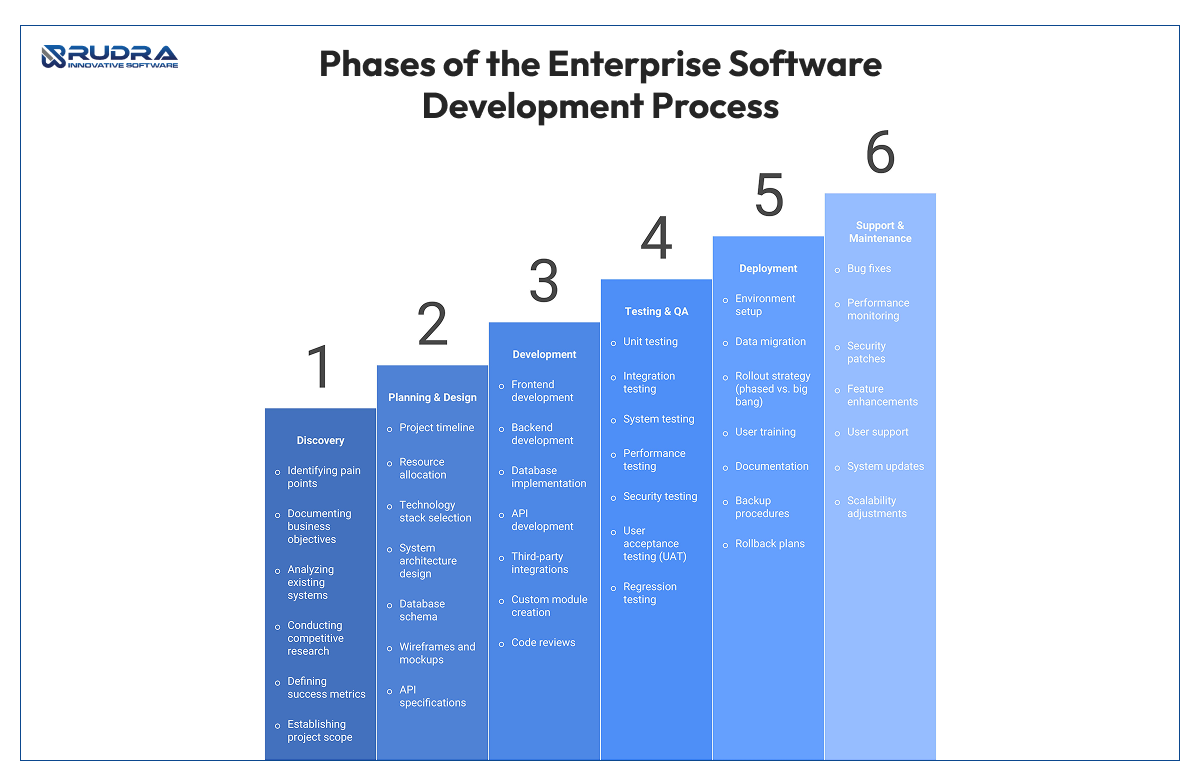
6 Phases of the Enterprise Software Development Process
Discovery
The discovery phase establishes the foundation for successful enterprise software development. This critical stage involves comprehensive stakeholder interviews, current system audits, workflow analysis, and requirements gathering.
Key activities include: identifying pain points, documenting business objectives, analyzing existing systems, conducting competitive research, defining success metrics, and establishing project scope.
Thorough discovery prevents costly changes later in development and ensures alignment between technical solutions and business needs. Organizations typically allocate 10-15% of the total project budget to this phase.
Planning & Design
During planning and design, teams create detailed roadmaps, architectural blueprints, and user interface designs. This phase transforms requirements into actionable development plans.
Critical deliverables: project timeline, resource allocation, technology stack selection, system architecture design, database schema, wireframes and mockups, API specifications, and security protocols.
Effective planning incorporates agile methodologies, allowing for iterative refinement while maintaining clear milestones. The design phase should involve end-users to ensure usability and adoption.
Development
The development phase brings designs to life through coding, configuration, and integration. Development teams typically work in sprints, delivering functional increments that can be reviewed and tested.
Development activities: frontend development, backend development, database implementation, API development, third-party integrations, custom module creation, and code reviews.
Modern enterprise development emphasizes modularity, reusability, and maintainability. Teams employ version control, continuous integration, and collaborative tools to ensure code quality and efficient collaboration.
Testing & QA
Comprehensive testing ensures the software meets functional requirements, performs reliably under load, and maintains security standards. Quality assurance is not a single phase but an ongoing process throughout development.
Testing types: unit testing, integration testing, system testing, performance testing, security testing, user acceptance testing (UAT), and regression testing.
Automated testing frameworks reduce manual effort while improving coverage. Organizations should allocate 25-30% of development time to testing activities to minimize post-deployment issues.
Deployment
Deployment transitions the software from development to production environments. Careful planning minimizes disruption to ongoing business operations.
Deployment considerations: environment setup, data migration, rollout strategy (phased vs. big bang), user training, documentation, backup procedures, and rollback plans.
Many organizations adopt continuous deployment practices, releasing smaller updates frequently rather than large releases periodically. This approach reduces risk and accelerates value delivery.
Support & Maintenance
Post-deployment support ensures continued system reliability, addresses emerging issues, and incorporates enhancements based on user feedback.
Ongoing activities: bug fixes, performance monitoring, security patches, feature enhancements, user support, system updates, and scalability adjustments.
Maintenance typically consumes 15-20% of initial development costs annually. Proactive monitoring and regular updates prevent technical debt and extend software lifespan.
Challenges of Enterprise Software Development
Security
Enterprise software handles sensitive business data, making security paramount. Organizations face sophisticated cyber threats including ransomware, data breaches, and insider threats.
Security challenges include: implementing robust authentication and authorization, encrypting data in transit and at rest, maintaining compliance with regulations (GDPR, HIPAA, SOC 2), managing access controls across large user bases, protecting APIs from unauthorized access, and responding to evolving threat landscapes.
Security must be integrated from the initial design phase rather than added as an afterthought. Regular security audits, penetration testing, and employee training are essential components of comprehensive security strategies.
Third-Party Integration
Modern enterprises rely on diverse software ecosystems, requiring seamless integration between systems. Integration challenges multiply as organizations use an average of 110 different SaaS applications.
Integration obstacles: incompatible data formats, varying API standards, version compatibility issues, authentication and authorization across systems, data synchronization, and maintaining integrations as systems evolve.
API-first architectures, middleware platforms, and integration specialists help organizations navigate these complexities. Investment in integration infrastructure pays dividends through improved data accessibility and process automation.
Frequent Changes
Business requirements evolve constantly due to market dynamics, regulatory changes, and organizational growth. Enterprise software must accommodate these changes without compromising stability.
Change management challenges: balancing flexibility with stability, maintaining system performance during updates, managing change requests from multiple stakeholders, ensuring backward compatibility, and controlling scope creep.
Agile methodologies, modular architecture, and strong change management governance help organizations adapt while maintaining control over development processes and budgets.
Data Storage
Enterprise applications generate and consume massive data volumes. Effective data storage strategies must address capacity, performance, accessibility, and cost considerations.
Data storage considerations: selecting appropriate database technologies (relational, NoSQL, data warehouses), implementing data archiving strategies, ensuring data backup and disaster recovery, optimizing query performance, managing storage costs, and maintaining data quality.
Cloud-native storage solutions provide scalability and cost-efficiency, though organizations must carefully evaluate data residency requirements and compliance obligations when selecting storage infrastructure.
Benefits of Enterprise Software Development
| Region | Notable Companies | Strength |
|---|---|---|
| Improved Efficiency | Automation reduces manual tasks by 30-50% | 6-12 months |
| Enhanced Collaboration | Centralized platforms improve team coordination | 3-6 months |
| Better Decision Making | Real-time data analytics enable informed choices | 6-18 months |
| Scalability | Systems grow with organizational needs | Ongoing |
| Cost Reduction | Streamlined processes cut operational expenses by 20-35% | 12-24 months |
| Competitive Advantage | Differentiated capabilities create market positioning | 12-36 months |
| Regulatory Compliance | Automated compliance reduces risk and penalties | Immediate |
| Customer Satisfaction | Improved service delivery increases retention by 15-25% | 6-12 months |
Enterprise software transforms how organizations operate, enabling them to respond faster to market changes, serve customers more effectively, and operate more efficiently. Companies that invest strategically in enterprise software report average productivity gains of 40% within two years of implementation.
Enterprise Software Development Best Practices
Microservices Architecture
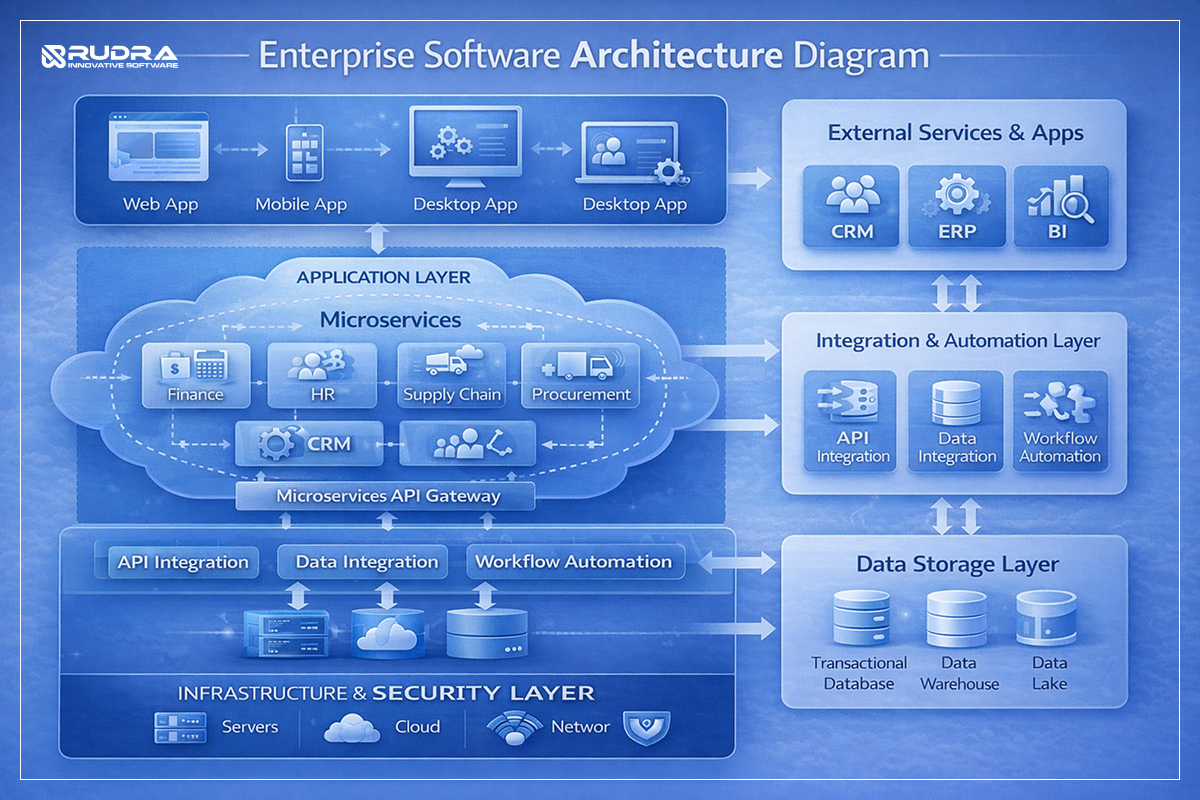
Microservices architecture decomposes applications into small, independent services that communicate through well-defined APIs. This approach offers significant advantages over monolithic architectures.
Benefits of microservices: independent deployment and scaling of services, technology diversity allowing teams to use optimal tools, fault isolation preventing system-wide failures, easier maintenance and updates, and improved team autonomy.
Implementation considerations: service boundaries must align with business capabilities, implement robust API gateway, establish service discovery mechanisms, ensure proper monitoring and logging, and define clear data ownership between services.
Leading enterprises including Netflix, Amazon, and Uber have successfully adopted microservices to achieve unprecedented scale and agility.
Cloud-Native Approach
Cloud-native development leverages cloud infrastructure characteristics to build resilient, scalable applications. This approach goes beyond simply hosting applications in the cloud.
Cloud-native principles: containerization using Docker and Kubernetes, dynamic orchestration and auto-scaling, microservices architecture, DevOps practices and CI/CD pipelines, and API-driven communication.
Advantages: reduced infrastructure costs, global availability and low latency, rapid provisioning and deployment, built-in redundancy and disaster recovery, and consumption-based pricing models.
Organizations adopting cloud-native approaches report 20-30% infrastructure cost savings and 50% faster time-to-market for new features.
Ensure Security
Security must be embedded throughout the development lifecycle rather than treated as a separate concern. This “security-by-design” approach minimizes vulnerabilities.
Security best practices: implement zero-trust architecture, conduct regular security assessments and penetration testing, use encryption for sensitive data, establish comprehensive access controls and audit trails, maintain security patch management processes, and provide security training for development teams.
DevSecOps integration: automated security scanning in CI/CD pipelines, infrastructure as code with security controls, container security scanning, and continuous compliance monitoring.
Select the Right Team
The success of enterprise software development heavily depends on team composition, expertise, and collaboration. Building the right team requires careful consideration of technical skills, domain knowledge, and cultural fit.
Essential team roles: solution architects, backend developers, frontend developers, UX/UI designers, QA engineers, DevOps engineers, project managers, and business analysts.
Team selection criteria: proven experience with enterprise-scale projects, expertise in relevant technologies and frameworks, strong communication skills, problem-solving abilities, and alignment with organizational culture.
Consider whether to build in-house teams, engage development partners, or adopt hybrid models based on strategic importance, required expertise, and resource availability.
Top Enterprise Software Development Companies
Rudra Innovative Software
Rudra Innovative Software specializes in custom enterprise solutions with particular strength in digital transformation initiatives. The company serves mid-market and enterprise clients across healthcare, finance, and manufacturing sectors.
Specializations: custom ERP development, CRM implementation, cloud migration services, and AI-powered business intelligence.
Notable strengths: deep domain expertise, agile delivery methodology, competitive pricing, and strong client retention rates.
Accenture
Accenture is a global professional services company offering end-to-end enterprise software services. With over 738,000 employees across 120+ countries, Accenture combines technology expertise with industry knowledge.
Core capabilities: enterprise architecture, SAP and Oracle implementation, cloud transformation, AI and analytics, and cybersecurity.
Differentiators: global delivery network, extensive partner ecosystem, innovation centers, and proven large-scale transformation experience.
Tata Consultancy Services (TCS)
TCS is one of the world’s largest IT services providers, known for reliable enterprise software delivery and strong client relationships. The company serves clients across all major industries.
Key offerings: application development and maintenance, enterprise package implementation, cloud services, digital transformation, and business process services.
Competitive advantages: mature delivery frameworks, cost-effective offshore delivery, comprehensive industry solutions, and strong quality processes.
Infosys
Infosys combines consulting, technology, and outsourcing services to deliver enterprise software solutions. The company emphasizes innovation and next-generation digital services.
Service portfolio: enterprise application services, cloud and infrastructure services, data and analytics, AI and automation, and digital experience services.
Strengths: strong innovation focus, design thinking approach, strategic partnerships with technology vendors, and comprehensive training programs.
Deloitte
Deloitte Digital brings together creative, technology, and business consulting capabilities to deliver enterprise solutions. The firm excels at complex transformations requiring both technology and organizational change.
Practice areas: enterprise technology implementation, custom application development, digital strategy, cloud engineering, and cybersecurity.
Unique value: integration of business strategy with technology implementation, C-suite relationships, industry-specific expertise, and global delivery capabilities.
Top 5 Enterprise Software Development Trends
Artificial Intelligence
AI is transforming enterprise software from reactive tools to proactive assistants that predict needs, automate decisions, and augment human capabilities.
AI applications in enterprise software: intelligent automation of routine tasks, predictive analytics for forecasting and planning, natural language processing for chatbots and document analysis, computer vision for quality control and security, and recommendation engines for personalized experiences.
Impact: Organizations implementing AI in enterprise systems report 30-40% productivity improvements and 25% cost reductions in automated processes. AI-powered enterprise applications are expected to grow from $62 billion in 2024 to $126 billion by 2026.
Implementation considerations: require quality training data, address algorithmic bias, maintain transparency and explainability, and ensure human oversight for critical decisions.
AI is rapidly becoming a core capability in enterprise software, not just an add-on.
Explore architectures, use cases, and real-world adoption strategies in our detailed guide: AI Software Development Services: Complete 2026 Enterprise Guide.
Blockchain
Blockchain technology provides distributed, immutable ledgers that enable transparency, traceability, and trust in enterprise processes without central authorities.
Enterprise blockchain use cases: supply chain traceability and provenance, smart contracts for automated agreement execution, secure credential verification and identity management, cross-border payments and settlements, and auditable records for compliance.
Benefits: reduced intermediary costs, enhanced security against tampering, improved transparency for stakeholders, faster transaction settlement, and automated compliance.
Industries including finance, healthcare, logistics, and manufacturing are piloting blockchain solutions. The enterprise blockchain market is projected to reach $94 billion by 2027.
Cloud Computing
Cloud computing continues evolving beyond simple infrastructure hosting to encompass platform services, serverless computing, and edge computing capabilities.
Emerging cloud trends: multi-cloud and hybrid cloud strategies, serverless and function-as-a-service (FaaS) architectures, edge computing for low-latency processing, cloud-native databases and storage, and FinOps for cloud cost optimization.
Strategic shift: organizations are moving from “cloud-first” to “cloud-smart” approaches, selecting optimal deployment models based on workload characteristics, data residency requirements, and cost considerations.
By 2026, Gartner predicts that 75% of organizations will have adopted a cloud-native approach for new enterprise applications.
DevOps
DevOps practices bridge development and operations teams, enabling faster delivery, improved quality, and better collaboration. Modern DevOps extends to include security (DevSecOps) and AI operations (AIOps).
Core DevOps practices: continuous integration and continuous deployment (CI/CD), infrastructure as code (IaC), automated testing and quality gates, containerization and orchestration, monitoring and observability, and collaborative culture and tools.
Measurable benefits: 200x more frequent deployments, 24x faster recovery from failures, 3x lower change failure rates, and 50% less time spent on unplanned work.
Advanced DevOps: AIOps uses machine learning to predict and prevent incidents, while GitOps extends DevOps principles to infrastructure management through declarative configurations.
Internet of Things (IoT)
IoT integration with enterprise software enables real-time monitoring, predictive maintenance, and data-driven optimization across physical assets and operations.
Enterprise IoT applications: predictive maintenance reducing equipment downtime, asset tracking and fleet management, environmental monitoring and energy optimization, smart building management, and connected product analytics.
Technical requirements: edge computing for real-time processing, robust device management platforms, secure IoT protocols, scalable data ingestion pipelines, and analytics for massive data volumes.
The number of enterprise IoT deployments is expected to reach 24.1 billion devices by 2026, generating unprecedented data volumes that require sophisticated enterprise software to process and extract value.
How Much Does It Cost to Develop Enterprise Software?
Enterprise software development costs vary significantly based on complexity, features, team composition, and development approach. Understanding cost drivers helps organizations budget appropriately and make informed decisions.
Cost breakdown by project size
| Project Scale | Timeline | Team Size | Estimated Cost Range |
|---|---|---|---|
| Small (Basic CRM, simple workflow) | 3-6 months | 4-6 developers | $50,000 – $150,000 |
| Medium (Departmental system, integration) | 6-12 months | 8-12 developers | $150,000 – $500,000 |
| Large (Multi-module ERP, complex features) | 12-24 months | 15-25 developers | $500,000 – $2,000,000 |
| Enterprise (Full digital transformation) | 24+ months | 30+ developers | $2,000,000 – $10,000,000+ |
Cost factors
- Technical complexity: Custom algorithms, AI/ML integration, real-time processing, and advanced security requirements increase costs
- Integration requirements: Connecting with multiple systems, legacy system integration, and API development add complexity
- User base: Applications supporting thousands of concurrent users require robust architecture and performance optimization
- Compliance needs: Industry-specific regulations (HIPAA, PCI-DSS, GDPR) require additional development and testing
- Technology stack: Emerging technologies may require specialized expertise at premium rates
- Location: Development team location significantly impacts hourly rates (see section 15)
- Ongoing costs: Organizations should budget 15-25% of initial development costs annually for maintenance, hosting, support, and incremental enhancements.
How to Hire an Enterprise Software Development Team
Selecting the right development partner or building an internal team is critical to project success. Poor team selection is the primary cause of project failures and cost overruns.
Steps to Hire the Right Team
Step 1: Define Your Requirements Clearly articulate project objectives, scope, technical requirements, timeline, and budget. Document must-have versus nice-to-have features to prioritize development efforts.
Step 2: Determine Engagement Model Choose between in-house development, outsourcing, staff augmentation, or hybrid models based on strategic importance, required expertise, and long-term maintenance considerations.
Step 3: Evaluate Technical Expertise Assess candidates’ proficiency in relevant technologies, frameworks, and methodologies. Review portfolios of similar projects, checking for complexity, scale, and successful outcomes.
Step 4: Verify Industry Experience Prioritize teams with domain expertise in your industry. Understanding industry-specific workflows, regulations, and challenges accelerates development and improves solution fit.
Step 5: Assess Communication and Collaboration Evaluate responsiveness, clarity of communication, and cultural compatibility. Successful enterprise projects require ongoing collaboration and mutual understanding.
Step 6: Review Development Processes Examine methodology (Agile, Scrum, DevOps), quality assurance practices, documentation standards, and project management approaches. Mature processes indicate lower project risk.
Step 7: Check References and Case Studies Contact previous clients to verify capabilities, reliability, and problem-solving abilities. Look for long-term client relationships indicating satisfaction and trust.
Step 8: Evaluate Support and Maintenance Understand post-deployment support offerings, SLA commitments, knowledge transfer processes, and pricing for ongoing services.
Step 9: Consider Scalability Ensure the team can scale resources up or down based on project phases and can support future enhancements and expansion.
Step 10: Negotiate Contract Terms Clearly define deliverables, milestones, payment terms, intellectual property ownership, confidentiality provisions, and dispute resolution mechanisms.
Steps Involved in Enterprise Software Development
While the six-phase process outlined in section 5 provides a high-level framework, successful enterprise software development involves numerous detailed activities:
1. Stakeholder Alignment
- Executive sponsorship and champion identification
- Cross-functional team formation
- Success criteria definition and KPI establishment
- Change management planning
2. Requirements Engineering
- Business process mapping and analysis
- User story development and prioritization
- Functional and non-functional requirements documentation
- Acceptance criteria definition
3. Solution Design
- High-level architecture design
- Technology stack selection and justification
- Database schema design
- API specification development
- Security architecture planning
- UI/UX wireframing and prototyping
4. Iterative Development
- Sprint planning and backlog grooming
- Feature development in increments
- Code reviews and pair programming
- Continuous integration setup
- Documentation creation
5. Comprehensive Testing
- Automated test suite development
- Performance and load testing
- Security vulnerability scanning
- User acceptance testing coordination
- Bug tracking and resolution
6. Deployment Preparation
- Infrastructure provisioning
- Deployment automation configuration
- Data migration planning and execution
- User training material development
- Rollback procedure documentation
7. Go-Live and Transition
- Phased rollout or big-bang deployment
- Hypercare support period
- Issue triage and rapid resolution
- User feedback collection
- Knowledge transfer to support teams
8. Continuous Improvement
- Performance monitoring and optimization
- Feature enhancement based on user feedback
- Security patch management
- Technology stack updates
- Scalability adjustments
Enterprise Software Development Examples
Workflow Tools Built by Enterprise Software
Case Study: Manufacturing Execution System
A global automotive manufacturer developed a custom manufacturing execution system (MES) to optimize production line efficiency and quality control.
Business challenge: Manual tracking of work-in-progress, quality defects, and equipment maintenance resulted in production delays, increased scrap rates, and reactive maintenance.
Solution components:
- Real-time production monitoring dashboards
- Automated quality inspection integration using computer vision
- Predictive maintenance algorithms analyzing sensor data
- Inventory management with automated replenishment
- Operator interface for work instructions and issue reporting
Results:
- 23% reduction in production cycle time
- 47% decrease in unplanned downtime
- 35% reduction in quality defects
- $8.2 million annual savings
- ROI achieved in 14 months
Technical implementation: Microservices architecture deployed on AWS, using Java Spring Boot for backend services, React for frontends, PostgreSQL for transactional data, TimescaleDB for time-series sensor data, and TensorFlow for predictive maintenance models.
CRM Software Development for Enterprises
Case Study: Financial Services CRM
A wealth management firm built a custom CRM to provide advisors with comprehensive client views and personalized engagement capabilities.
Business challenge: Advisors used multiple disconnected systems for client data, communications, portfolio management, and compliance documentation, resulting in fragmented client experiences and compliance risks.
Solution features:
- Unified client profile aggregating data from 12 source systems
- AI-powered next-best-action recommendations
- Automated compliance documentation and audit trails
- Integrated communication hub (email, calls, meetings, documents)
- Advanced analytics and client segmentation
- Mobile app for advisors with offline capabilities
Results:
- 40% increase in advisor productivity
- 28% improvement in client retention
- 100% compliance audit success rate
- 52% reduction in administrative time
- $15 million revenue increase attributed to improved client engagement
Technical architecture: Built on Microsoft Azure using .NET Core microservices, Angular frontend, Azure SQL Database, Azure Cognitive Services for AI recommendations, and integration with Salesforce Marketing Cloud, Fiserv portfolio system, and Microsoft 365.
How Much Does It Cost to Hire Enterprise Software Developers (by Location)?
Developer rates vary significantly by geographic location, expertise level, and technology specialization. Understanding these variations helps organizations optimize development costs while accessing required talent.
Average hourly rates by region (2026):
| Location | Junior Developer ($/hr) | Mid-Level Developer ($/hr) | Senior Developer ($/hr) | Architect / Lead ($/hr) |
|---|---|---|---|---|
| North America | ||||
| United States (Major Tech Hubs) | $80-120 | $120-180 | $180-250 | $250-350+ |
| United States (Secondary Markets) | $60-90 | $90-140 | $140-200 | $200-280 |
| Canada | $50-75 | $75-115 | $115-165 | $165-230 |
| Western Europe | ||||
| United Kingdom | $50-80 | $80-125 | $125-180 | $180-250 |
| Germany | $45-70 | $70-110 | $110-160 | $160-220 |
| France | $40-65 | $65-100 | $100-145 | $145-200 |
| Eastern Europe | ||||
| Poland | $30-45 | $45-70 | $70-100 | $100-140 |
| Ukraine | $25-40 | $40-60 | $60-90 | $90-130 |
| Romania | $25-40 | $40-60 | $60-85 | $85-120 |
| Asia | ||||
| India | $15-25 | $25-40 | $40-65 | $65-95 |
| Philippines | $15-25 | $25-40 | $40-60 | $60-85 |
| Vietnam | $15-25 | $25-35 | $35-55 | $55-80 |
| Latin America | ||||
| Brazil | $25-40 | $40-60 | $60-85 | $85-120 |
| Argentina | $25-35 | $35-55 | $55-80 | $80-110 |
| Mexico | $30-45 | $45-65 | $65-95 | $95-135 |
Considerations beyond hourly rates:
- Communication efficiency: Time zone alignment and language proficiency affect collaboration quality
- Cultural compatibility: Work styles, business practices, and expectation alignment impact project success
- Infrastructure and tools: Some regions have better technology infrastructure and access to modern development tools
- Legal and IP protection: Intellectual property laws and contract enforceability vary by jurisdiction
- Total cost of ownership: Management overhead, travel costs, and potential quality issues should be factored
- Talent availability: Specialized skills (AI/ML, blockchain, specific enterprise platforms) command premium rates globally
Optimal strategies: Many organizations adopt hybrid models, combining onshore teams for strategy, architecture, and stakeholder engagement with offshore teams for development and testing, achieving cost optimization while maintaining quality and control.
Conclusion
Enterprise software development represents a strategic investment that can transform organizational capabilities, drive competitive advantage, and enable sustainable growth. Success requires careful planning, appropriate resource allocation, and ongoing commitment to quality and innovation.
Frequently Asked Questions (FAQs)
1. How much does enterprise software development cost?
Enterprise software development typically costs between $40,000 and $300,000+, depending on complexity, features, integrations, security requirements, and the development team’s location.
2. How long does it take to develop enterprise software?
Most enterprise software projects take 6 to 18 months, covering discovery, design, development, testing, and deployment phases.
3. What are the most common types of enterprise software?
Common types include ERP, CRM, Business Intelligence (BI), Supply Chain Management, and Enterprise Resource Management systems.
4. Which development model is best for enterprise software?
Agile and DevOps models are widely preferred because they enable flexibility, faster releases, continuous testing, and ongoing improvement.
5. Is cloud-based enterprise software better than on-premise?
Cloud-based enterprise software provides better scalability, cost efficiency, and faster deployment, while on-premise solutions are chosen when strict data control, security, or compliance requirements are necessary.