Digital transformation has become one of the most overused phrases in business and one of the most misunderstood. For some executives, it means moving files to the cloud. For others, it means a new CRM, an AI pilot project, or a complete overhaul of how the company operates. The truth is that digital transformation is none of these things in isolation, and all of them when done correctly.
This guide breaks down what digital transformation actually means for your business, why the pressure to act on it is no longer optional, and how leadership teams are approaching it in a way that produces measurable results instead of stalled initiatives. Whether you’re just starting to evaluate your organization’s readiness or you’re trying to course-correct a transformation effort that’s lost momentum, this is the starting point.
It’s also worth being honest about the odds from the outset. According to McKinsey’s global transformation research, roughly 70% of digital transformation initiatives fail to meet their original objectives. That statistic isn’t a reason to avoid transformation the cost of standing still is higher than the cost of a difficult initiative but it is a strong argument for understanding what separates the organizations that succeed from the ones that don’t before committing significant budget and political capital to the effort.
What Digital Transformation Actually Means
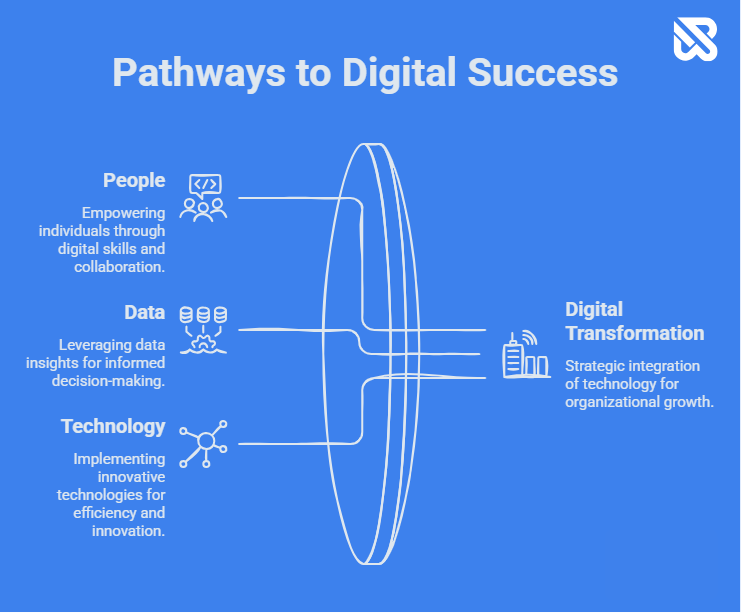
Digital transformation is the integration of digital technology into every part of a business, resulting in fundamental changes to how the organization operates and delivers value to customers. It is not a single project with a defined end date. It is an ongoing shift in how a business thinks, competes, and creates value, with technology as the enabler rather than the goal itself.
This distinction matters because it’s often confused with two related but narrower concepts.
- Digitization is the process of converting analog information into digital format turning paper records into PDFs, for example. It’s a foundational first step, but on its own it changes very little about how a business actually operates.
- Digitalization goes a step further, using digital technologies to change existing business processes. Automating an approval workflow that used to require physical signatures is digitalization. It improves efficiency, but it’s still optimizing what already exists.
- Digital transformation is different in kind, not just degree. It asks a harder question: if you were building this business today, with today’s technology, would you build it the way it currently operates? Often the answer is no and that gap is what digital transformation is meant to close. It touches strategy, culture, customer experience, and operating model simultaneously, not just the tools employees use day to day.
For a business leader, the practical takeaway is this: if your transformation initiative is only about adopting new software, you’re digitalizing, not transforming. Real transformation changes how decisions get made, how value gets delivered, and how the organization is structured to compete.
| Term | What It Means | Example | Business Impact |
|---|---|---|---|
| Digitization | Converting analog information to digital format | Scanning paper contracts into PDFs | Foundational; minimal process change |
| Digitalization | Using digital tools to improve existing processes | Automating an approval workflow | Improves efficiency of current operations |
| Digital Transformation | Reimagining the business model and operations using digital capability | Rebuilding the customer journey around real-time data and AI-driven personalization | Changes how the business creates and delivers value |
Why It Matters Now
Digital transformation has been a boardroom topic for over a decade, but three forces have made it considerably more urgent in the last few years.
Competitive pressure has compressed timelines. Companies that transformed early particularly in how they use data and automation are now operating with cost structures and speed-to-market advantages that are difficult for slower-moving competitors to close. The gap between digital leaders and laggards within the same industry continues to widen rather than narrow.
Customer expectations have permanently shifted. B2B buyers now expect the same speed, personalization, and self-service capability they experience as consumers. A clunky, manual buying or service experience is no longer just an inconvenience; it’s a reason to choose a competitor.
AI has changed the economics of transformation. Capabilities that once required large engineering teams and multi-year builds predictive analytics, intelligent automation, personalization at scale are now accessible through tools that can be implemented in months. This has lowered the barrier to transformation, but it has also raised the cost of standing still, since competitors can now move faster with less investment than before.
None of this means transformation should be rushed. It means the cost of an unclear or stalled strategy has gone up, and the organizations treating this as a back-burner initiative are the ones most likely to be disrupted by those who don’t.
“There is a tendency to see digital technology as an opportunity or choice. However, the mounting pressures of a rapidly shifting business landscape are turning digital from a choice into an imperative. The longer a business waits, the more marginalized it will become.” — John Hagel, former Co-chairman, Deloitte Center for the Edge
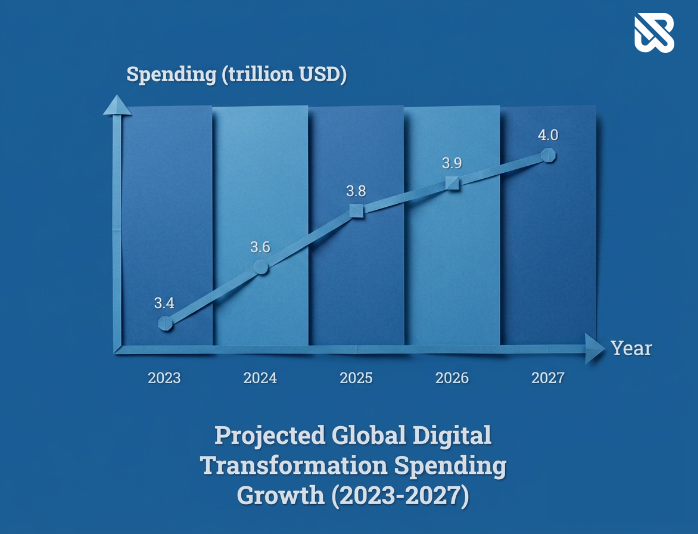
The investment numbers reflect this shift. Global spending on digital transformation is projected to approach $4 trillion by 2027, growing at roughly 16% annually. The organizations driving that spending aren’t doing so out of enthusiasm for new technology they’re doing it because the alternative is ceding ground to competitors who move faster.
The Core Pillars of Digital Transformation
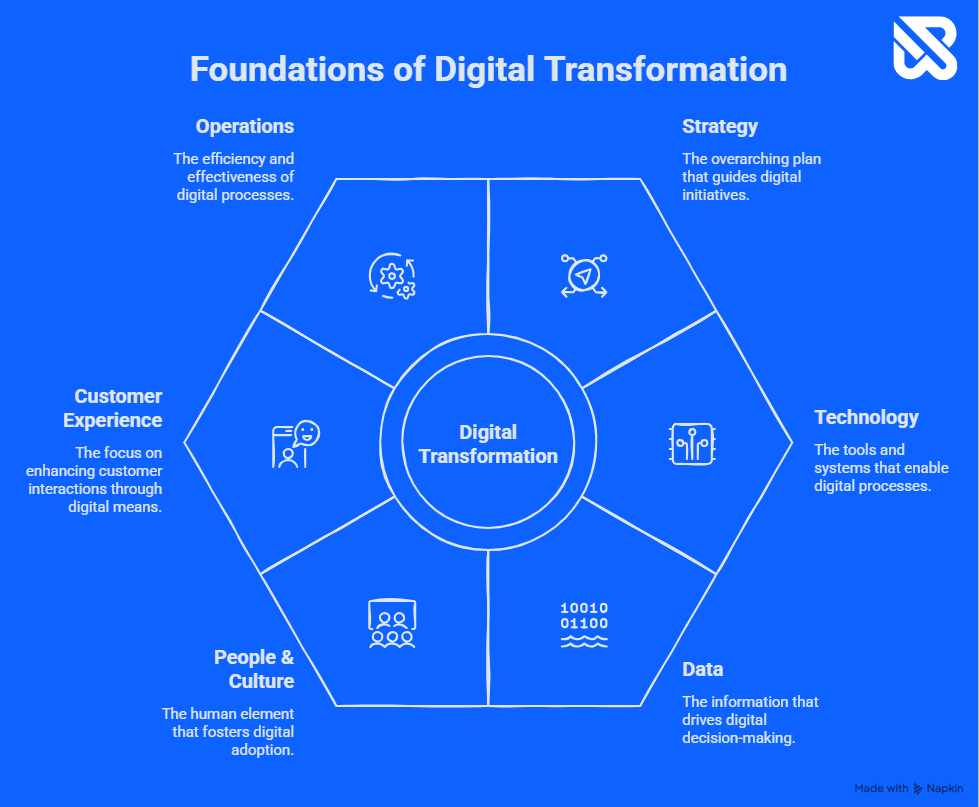
Successful transformation efforts tend to address the same six areas, in some order. Skipping any one of them is the most common reason transformation initiatives stall after an initial burst of progress.
Strategy & Leadership Alignment
Transformation that isn’t tied to a clear business strategy becomes a collection of disconnected technology projects. Before any technology decision is made, leadership needs alignment on what the transformation is actually meant to achieve faster growth, lower cost-to-serve, new revenue models, improved customer retention and which of these takes priority when trade-offs arise. Without this, departments tend to pursue their own definitions of transformation, and the result is fragmented progress that doesn’t add up to organizational change.
Technology & Infrastructure
This is the layer most people associate with digital transformation, and it includes the systems, platforms, and architecture that make everything else possible cloud infrastructure, core business systems, integration capability, and increasingly, AI and automation tools. The goal here isn’t simply adopting newer technology; it’s building infrastructure flexible enough to support change as the business and market continue to evolve. Legacy systems that can’t integrate with newer tools are frequently the single biggest technical obstacle organizations face.
Data & Analytics
Transformation runs on data, but most organizations have it scattered across systems that don’t talk to each other. Establishing clean, accessible, and well-governed data is what allows everything downstream personalization, predictive insights, AI applications to actually work. Organizations that try to layer AI or advanced analytics on top of fragmented, low-quality data tend to see disappointing results, not because the technology fails, but because the data foundation was never built. Research from BCG found that organizations with strong systems integration achieve returns roughly 10 times higher than those with poor integration a gap that traces directly back to whether the underlying data architecture was built to support transformation in the first place.
People & Culture / Change Management
This is consistently the most underestimated pillar and the most common reason transformation efforts fail. New technology introduced into an organization that hasn’t prepared its people for new ways of working tends to be underused, worked around, or quietly abandoned. Successful transformation requires investment in training, clear communication about why change is happening, and visible leadership commitment not just a new tool rollout with a one-time announcement.
The disconnect here shows up clearly in the data. In a McKinsey global survey, 87% of executives identified organizational culture as the single biggest barrier to digital transformation. Yet those same organizations allocated less than 12% of total transformation budget to cultural and behavioral change initiatives. Leadership consistently recognizes where the risk lies and consistently underfunds the response to it.
Customer Experience
For most organizations, the ultimate test of transformation is whether the customer notices. This includes how customers discover, evaluate, buy from, and get supported by the business across digital channels. Internal efficiency gains that don’t eventually translate into a better customer experience tend to be harder to justify and sustain over time, particularly when seeking continued investment from leadership.
Operations & Process
Transformation eventually has to show up in how work actually gets done in workflows, handoffs between teams, and the elimination of manual, redundant, or error-prone processes. This is where automation and AI tend to deliver the clearest, most measurable ROI, because process inefficiencies are usually easier to quantify than strategic or cultural gains.
Common Roadblocks Executives Face
Knowing the pillars is one thing; navigating the obstacles that prevent progress is another. The same roadblocks tend to appear across industries and company sizes.
- Justifying the budget. Digital transformation often requires significant upfront investment with returns that materialize over quarters or years, not weeks. Without a clear way to tie investment to business outcomes, transformation budgets are frequently the first thing cut when priorities shift.
- Organizational resistance to change. Employees and even leadership can be hesitant to adopt new systems or ways of working, particularly when previous change initiatives were poorly managed or failed to deliver. This resistance is rarely about the technology itself it’s about trust in how change is being led.
- Legacy systems and technical debt. Many organizations are running critical operations on systems that are decades old, deeply customized, and poorly documented. Replacing or integrating around these systems is often more complex, expensive, and risky than initial transformation plans account for.
- Unclear or unmeasured ROI. Transformation initiatives that don’t define success metrics upfront struggle to demonstrate value later, which makes it difficult to secure continued investment or organizational buy-in for the next phase.
- Lack of cross-functional alignment. Transformation efforts led entirely by IT, or entirely by a single business unit, tend to optimize for that function’s needs rather than the organization’s. The most resilient transformation efforts have visible sponsorship from the CEO or another senior executive with authority across departments.
These roadblocks are predictable, which means they’re also avoidable with the right planning and they’re frequently the exact point where bringing in outside expertise changes the trajectory of an initiative that’s otherwise at risk of stalling.
Navigating these roadblocks alone is where most transformation efforts lose momentum. If your organization is hitting friction on strategy, data, or execution, our digital transformation services are built to help you move past it not just point it out.
This is sometimes called the “busy transformation” trap, and it’s more common in large enterprises than almost any other failure mode: plenty of visible motion, very little measurable progress.
Here’s a quick reference for how the six pillars connect to common roadblocks, and where to focus first:
| Pillar | Most Common Roadblock | Where to Start |
|---|---|---|
| Strategy & Leadership | Lack of cross-functional alignment | Secure executive sponsorship and a single set of priorities |
| Technology & Infrastructure | Legacy systems and technical debt | Audit current systems before adding new ones |
| Data & Analytics | Fragmented, siloed data | Establish a single source of truth before scaling AI |
| People & Culture | Underfunded change management | Budget for training and communication, not just tools |
| Customer Experience | Internal focus over customer focus | Map the customer journey before redesigning internal processes |
| Operations & Process | Unclear or unmeasured ROI | Define success metrics before launching the initiative |
A Practical Framework for Getting Started
Organizations at different stages of digital maturity need different starting points. Broadly, most companies fall into one of four stages:
Stage 1: Ad hoc. Technology adoption is reactive and inconsistent across departments. There’s no unified strategy, and digital initiatives are typically driven by individual teams solving their own immediate problems.
Stage 2: Foundational. Core systems are in place cloud infrastructure, basic data integration, foundational automation but they were implemented piecemeal rather than as part of a cohesive plan. The building blocks exist, but they’re not yet working together.
Stage 3: Integrated. Systems and data are connected across departments, supporting more consistent processes and better visibility into performance. Leadership has a documented strategy, and technology decisions are made with that strategy in mind rather than department by department.
Stage 4: Adaptive. The organization can adjust its technology and processes in response to new opportunities or market shifts relatively quickly. Data and AI are embedded into decision-making rather than treated as separate initiatives. Transformation is no longer a project it’s a continuous capability.
| Stage | Characteristics | Technology Maturity | Strategic Focus |
|---|---|---|---|
| 1. Ad Hoc | Reactive, inconsistent, team-led initiatives | Fragmented tools, no integration | Solve immediate, isolated problems |
| 2. Foundational | Core systems exist but aren’t unified | Cloud adoption begun, basic automation | Build consistent infrastructure |
| 3. Integrated | Connected systems and data across departments | Cross-functional integration, documented strategy | Align technology to business strategy |
| 4. Adaptive | Continuous, embedded transformation capability | AI and data embedded in decision-making | Sustain competitive agility |
Most organizations significantly overestimate which stage they’re in. Identifying your actual stage not the stage you’d like to be at is the necessary first step before building a roadmap, because the right next move looks very different for a Stage 1 organization than a Stage 3 one. It’s worth noting that only about 7% of companies report having fully completed their digital transformation journey which is less a discouraging statistic than a reminder that this is genuinely a continuous capability, not a finish line most organizations are realistically racing toward.
How to Choose the Right Approach: Build vs. Partner
Once leadership has clarity on strategy and current maturity stage, the next decision is how to execute: build the capability internally, bring in outside expertise, or some combination of both.
Handling transformation entirely in-house tends to work well when the organization already has strong internal technical talent, the bandwidth to dedicate to a multi-year initiative without disrupting day-to-day operations, and prior experience successfully managing large-scale change. It tends to work poorly when any of those conditions are missing, which is more common than not, particularly for the strategic and change-management dimensions of transformation rather than the purely technical ones.
Bringing in an outside partner tends to make sense when the organization needs specialized expertise it doesn’t have internally, wants to move faster than internal teams alone could manage, or has tried an internal-only approach before and seen it stall. The right partner doesn’t just implement technology they bring an outside perspective on strategy, help navigate the organizational resistance discussed earlier, and have seen which approaches tend to work across many organizations rather than just one.
Most successful transformations end up being a hybrid: internal teams retain ownership of strategy and institutional knowledge, while an outside partner provides specialized capability, accelerates execution, and helps avoid the common pitfalls that come from learning by trial and error on a first attempt.
Conclusion
Digital transformation is no longer a future-facing initiative reserved for companies with the biggest budgets or the boldest five-year plans it’s become the baseline cost of staying competitive. The organizations getting this right aren’t necessarily the ones spending the most; they’re the ones treating transformation as a continuous capability built on clear strategy, strong data foundations, and genuine investment in the people who have to make the change stick.
The roadmap is rarely the hard part. Most leadership teams can articulate, in broad strokes, where they want to end up. What separates the 70% of initiatives that stall from the ones that deliver measurable results is discipline in execution knowing your actual starting point rather than the one you’d like to claim, funding culture and change management with the same seriousness as technology, and bringing in the right expertise at the right moments instead of trying to solve every dimension of change alone.
If there’s one takeaway worth carrying forward, it’s this: digital transformation succeeds when it’s treated as how the business operates, not as a project that eventually finishes. That shift in mindset, more than any single tool or platform, is what determines whether an organization is still asking “are we transforming?” five years from now, or has simply become the kind of business that never stopped.
Ready to Move From Strategy to Execution?
Understanding digital transformation is the first step. Acting on it with a clear strategy, the right technology, and a team that’s prepared for change is what actually moves the business forward. Our team works with leadership across industries to design and implement transformation initiatives that deliver measurable results, not just activity.
Frequently Asked Questions (FAQs)
1. What is digital transformation in simple terms?
Digital transformation is the process of using digital technologies to fundamentally improve how a business operates, serves customers, and creates value. It involves more than adopting new tools—it requires rethinking processes, strategies, and organizational culture.
2. What is the difference between digitization, digitalization, and digital transformation?
Digitization is the conversion of physical or analog information into digital formats. Digitalization uses digital technologies to improve existing business processes. Digital transformation goes further by reshaping business models, operations, and customer experiences through technology-driven innovation.
3. Why do most digital transformation initiatives fail?
Many digital transformation efforts fail due to organizational challenges such as unclear goals, weak leadership support, poor change management, fragmented data systems, and insufficient employee adoption rather than technology limitations.
4. How long does digital transformation take?
Digital transformation is an ongoing journey rather than a one-time project. Initial planning and implementation may take 6–18 months, while measurable business outcomes often emerge within 1–3 years.
5. How much does digital transformation cost?
The cost varies significantly based on company size, industry, project scope, and technology requirements. Investments can range from focused six-figure initiatives to multi-year, multi-million-dollar enterprise transformation programs.
6. Should we handle digital transformation in-house or hire a partner?
The right approach depends on your internal expertise, available resources, and transformation goals. Many organizations adopt a hybrid model, maintaining strategic ownership internally while partnering with specialists for implementation and execution.
7. How do you measure digital transformation ROI?
Digital transformation ROI should be measured using business outcomes such as revenue growth, operational efficiency, customer retention, productivity improvements, and decision-making speed rather than simply tracking technology adoption metrics.