One of the first questions every leadership team asks before committing to a transformation initiative is also the hardest one to answer cleanly: what is the real digital transformation cost for a business like ours?
The honest answer is that digital transformation costs vary dramatically from under $100,000 for a focused, single-function initiative to well over $27 million for a large enterprise undertaking full-scale transformation. That spread isn’t a dodge. It reflects the fact that “digital transformation” covers an enormous range of scope, ambition, and organizational complexity.
What this guide does is break that range down into something actionable by company size, by what you’re actually spending money on, and by what the research says about the relationship between investment level and actual business outcomes.
Why There’s No Single Answer
Most digital transformation projects fail not because of bad technology, but because of unrealistic budgets and expectations. That failure pattern starts before the initiative does – with organizations either significantly underestimating what transformation actually requires, or conflating “buying new software” with the full cost of changing how the business operates.
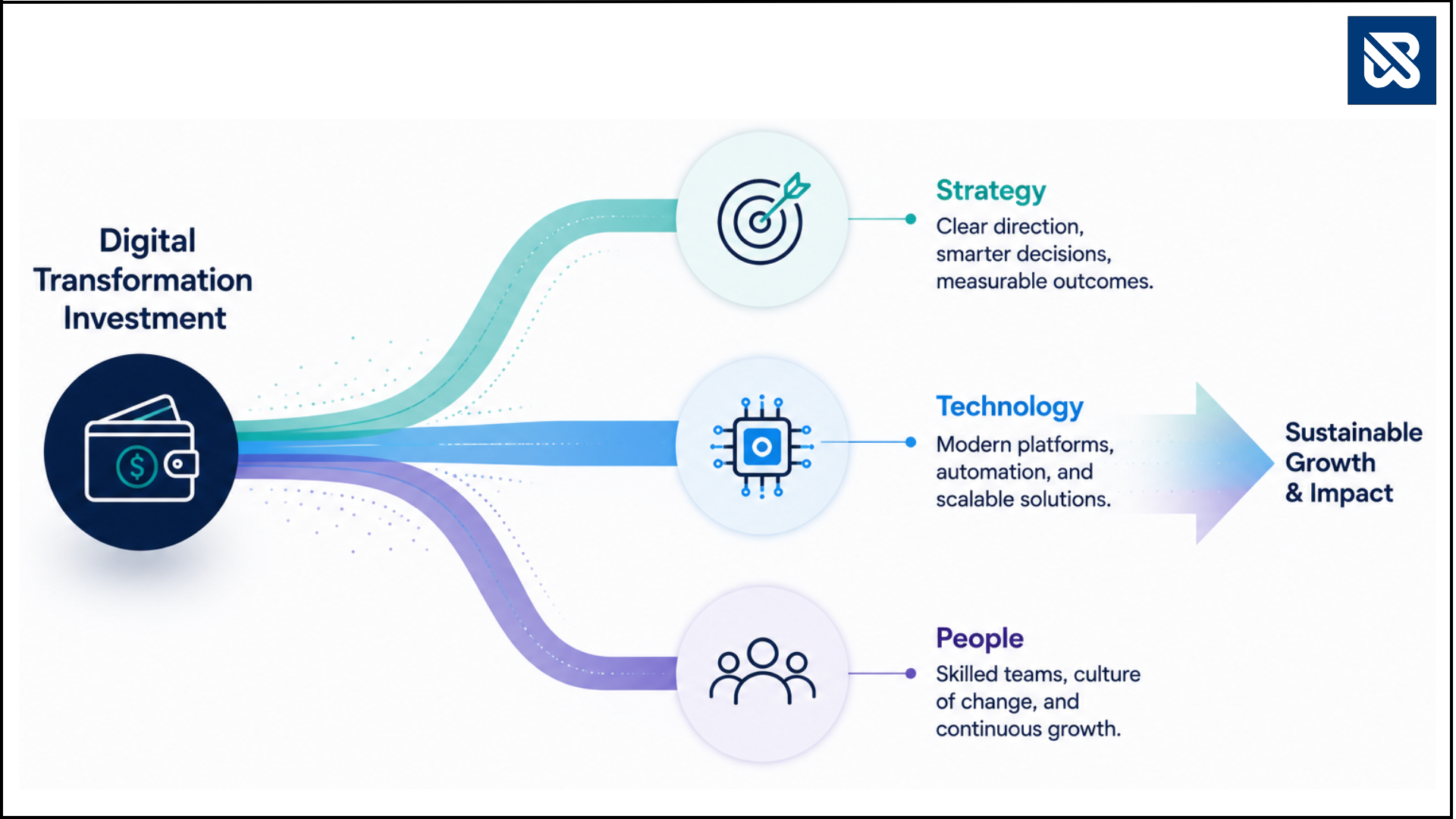
The cost of digital transformation is determined by several variables that are unique to every organization:
- Scope – are you transforming a single function (e.g. finance operations or customer service) or the entire business model?
- Legacy complexity – organizations with decades of custom-built systems and technical debt consistently spend more to integrate, replace, or work around them
- Industry – regulated industries (financial services, healthcare) carry compliance overhead that adds cost at every layer
- Build vs. partner – internal execution versus bringing in outside expertise has significant cost implications in both directions
- Change management investment – the organizations that fund training, communication, and cultural change adequately tend to spend more upfront but avoid the much higher cost of failed adoption
“Planning a digital transformation budget feels like trying to price a custom home without knowing whether it’s a cabin or a mansion. The numbers businesses encounter range dramatically and for good reason.”
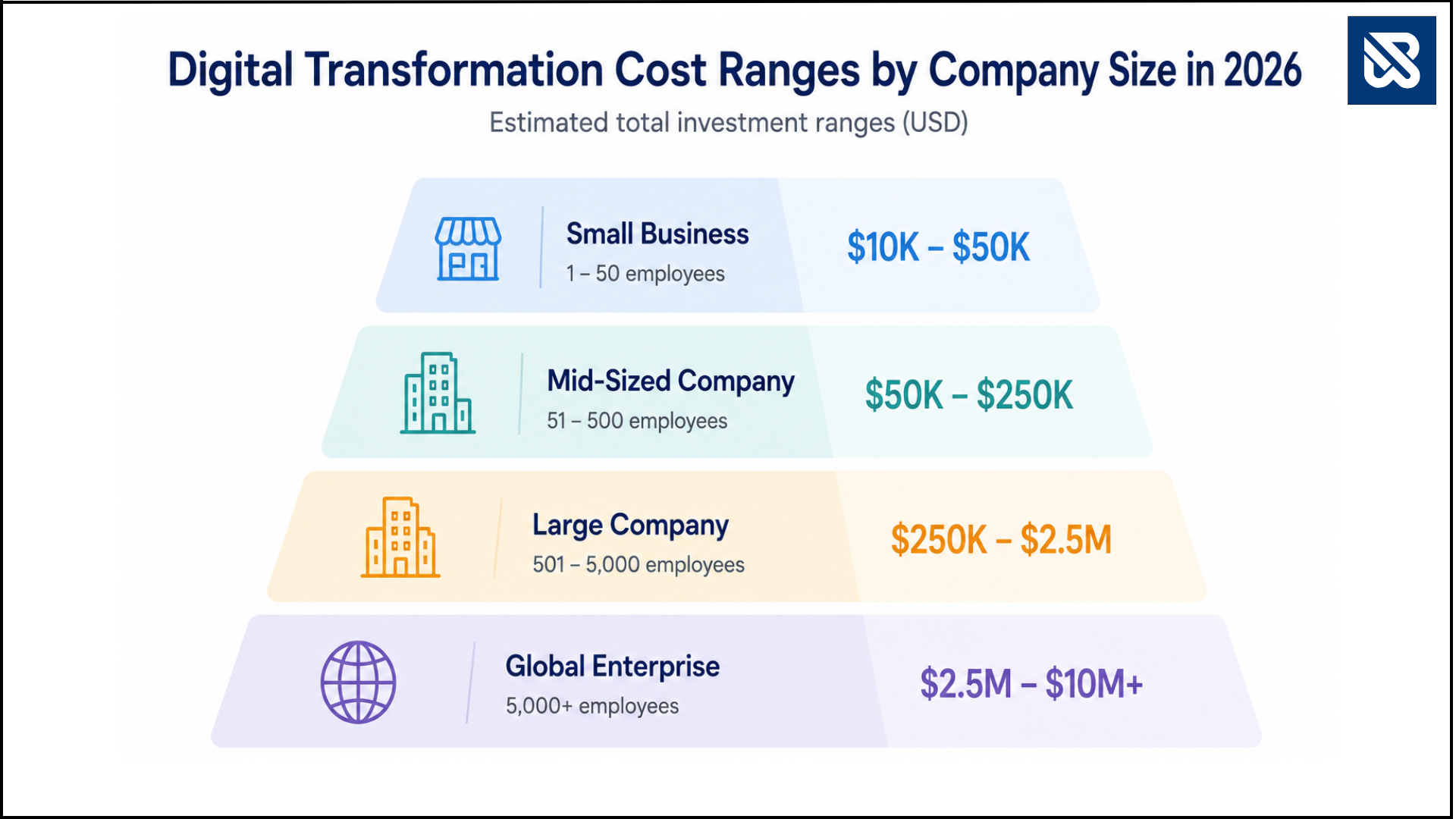
Digital Transformation Cost by Company Size
Digital transformation costs range from $50,000 for small-scope projects to $27.5 million for large enterprise initiatives, with most mid-sized companies investing $250,000–$5 million.
Here’s how those ranges break down more specifically:
| Company Size | Typical Annual Investment | Scope |
|---|---|---|
| Small business (under 100 employees) | $50,000 – $500,000 | Single function, focused initiative (e.g. automating one core process) |
| Mid-market (100–1,000 employees) | $500,000 – $5 million | Multi-function transformation, cloud migration, ERP modernization |
| Large enterprise (1,000–10,000 employees) | $5 million – $15 million | Cross-functional transformation, data infrastructure, AI integration |
| Global enterprise (10,000+ employees) | $15 million – $35 million+ | Full-scale transformation across business units, geographies, and systems |
Digital transformation projects in 2026 cost most mid-to-large companies $15–35 million from start to meaningful scale. Smaller businesses pull off focused changes for $3–12 million without breaking the bank.
What You’re Actually Paying For
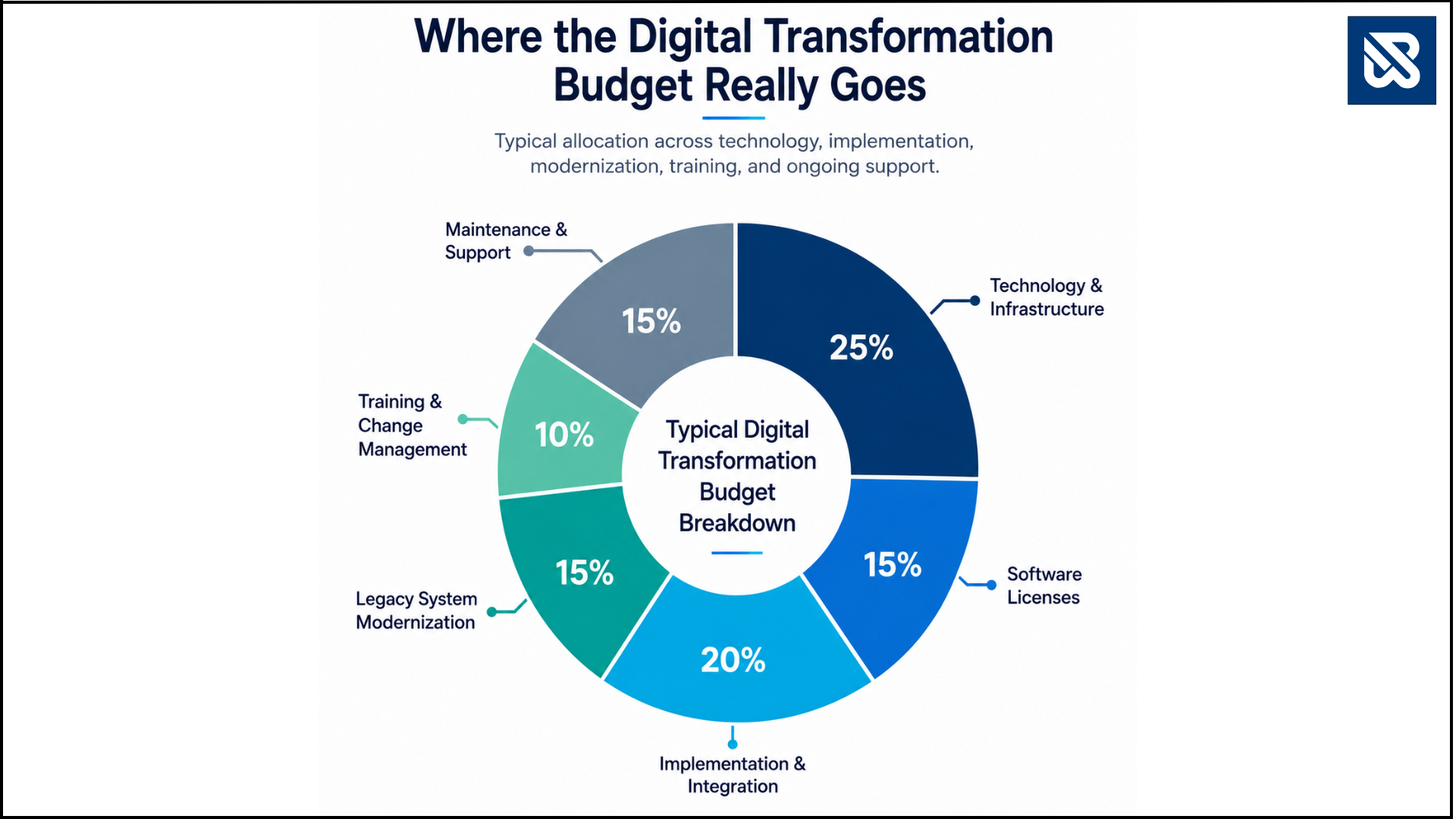
Understanding where the money goes is more useful than the headline number. Most transformation budgets are split across six cost categories, and the balance between them tells you a lot about whether an initiative is likely to succeed.
| Cost Category | Typical % of Budget | What It Covers |
|---|---|---|
| Technology & infrastructure | 30–40% | Cloud platforms, software licenses, integration tools, hardware |
| Implementation & integration | 20–30% | System builds, migrations, API integrations, custom development |
| Change management & training | 10–20% | Employee training, communication, adoption programs |
| Strategy & consulting | 10–15% | Roadmap design, architecture planning, outside expertise |
| Data & analytics | 10–15% | Data governance, analytics platforms, BI tools |
| Ongoing maintenance & support | 10–15% | Post-launch support, platform updates, continuous improvement |
The category that is most consistently underfunded and most consistently cited as the reason initiatives fail is change management and training. Organizations allocate on average less than 12% of transformation budget to the people side of change, even though the research consistently identifies culture and adoption as the primary failure driver. The cost of getting this wrong is rarely visible in the budget line, but it shows up clearly in post-launch adoption rates and ROI that never materializes.
The Revenue Rule of Thumb
For organizations that want a quick sanity check on their planned investment before getting into detailed scoping, the most widely cited benchmark in the industry is a percentage-of-revenue rule.
In 2026, businesses typically allocate 5–15% of annual revenue for digital transformation costs, covering tech investments and implementation. This varies by company size and sector.
| Annual Revenue | 5% Investment | 10% Investment | 15% Investment |
|---|---|---|---|
| $5 million | $250,000 | $500,000 | $750,000 |
| $25 million | $1.25 million | $2.5 million | $3.75 million |
| $100 million | $5 million | $10 million | $15 million |
| $500 million | $25 million | $50 million | $75 million |
Where your organization lands within that 5–15% range depends largely on urgency, competitive pressure, and current maturity stage. Organizations at Stage 1 or 2 of the maturity model (ad hoc or foundational) typically need to invest closer to the higher end of that range to close the gap while Stage 3 organizations maintaining and extending an already-integrated architecture can often sustain progress at the lower end.
Hidden costs derail more transformation initiatives than bad technology ever will. Our Digital Transformation Services are built to surface these risks early before they become budget overruns.
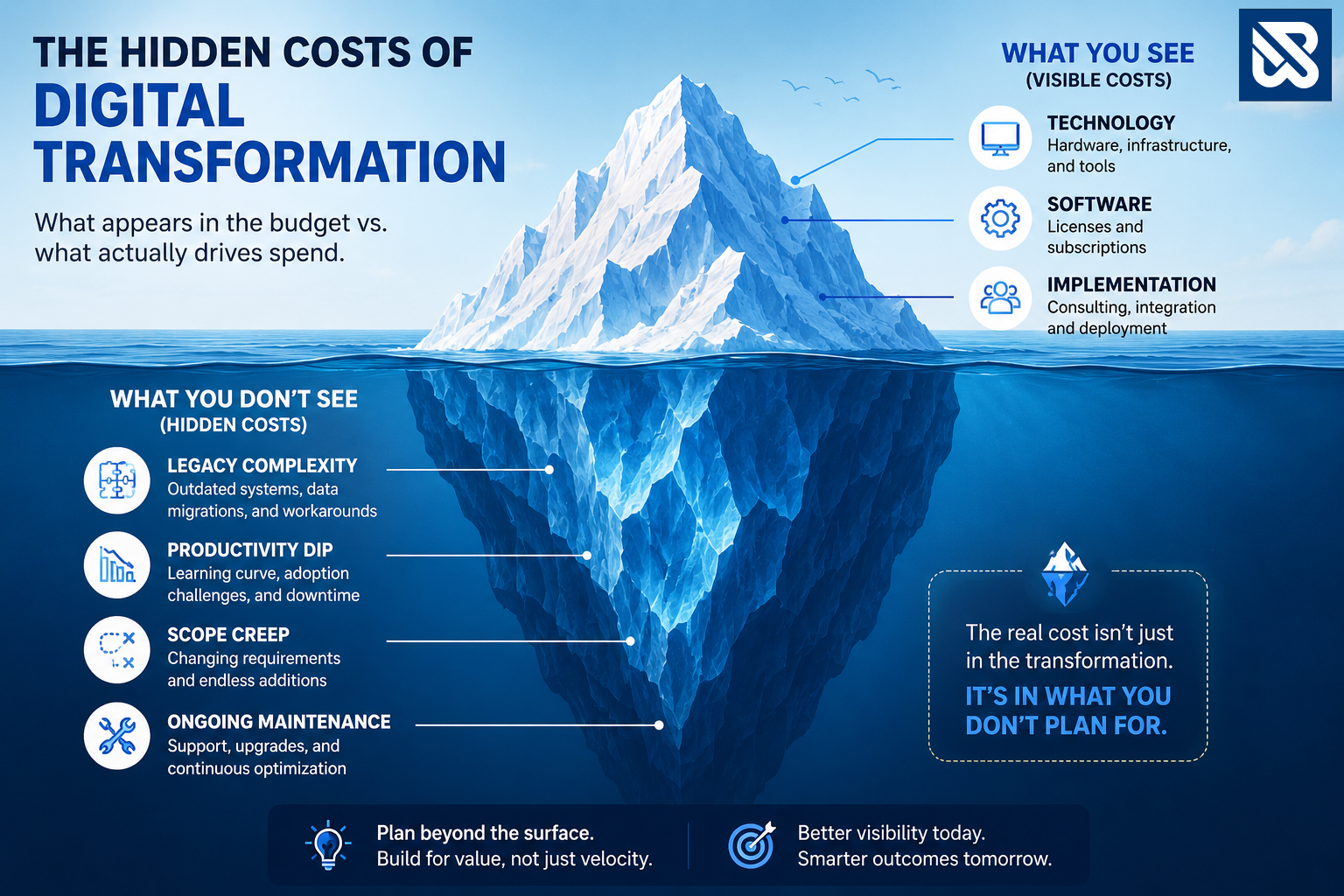
Hidden Costs Leadership Teams Often Miss
The headline budget number is rarely the number organizations actually spend. Several categories of cost are consistently underestimated or overlooked entirely in early planning.
Legacy system complexity. The true cost of working around, integrating with, or replacing old systems is almost always higher than initial estimates suggest both in direct cost and in the time it adds to implementation timelines.
Talent and skills gaps. Transformation often reveals that the internal skills required to operate new systems don’t fully exist yet. Hiring, upskilling, or contracting for those capabilities adds budget that rarely appears in the initial business case.
Hidden maintenance and licensing costs. Hidden costs like training, integration, and change management can increase budgets by 20–40% if not properly planned. Subscription costs for cloud platforms, software licenses, and ongoing technical support compounds over time in ways that are easy to underestimate when signing initial contracts.
Productivity dip during transition. The period during and immediately after a major system change typically sees a temporary drop in operational efficiency as employees adapt. This rarely appears as a line item but has a real cost in output and, in some cases, customer experience.
Scope creep. Transformation initiatives almost universally expand in scope once leadership teams see what becomes possible as new systems come online. Building contingency budget (typically 15–20% above the planned number) into the original business case is standard practice for experienced teams.
What the Investment Buys: Expected ROI
The more important question for most leadership teams isn’t “how much does this cost?” – it’s “what return should we expect?”
The research on transformation ROI is clear about one thing: the range of outcomes is extremely wide, and the difference between strong and weak returns traces almost entirely to how well the initiative was planned and executed – not how much was spent.
Smaller organizations, those with fewer than 100 employees, are 2.7 times more likely to succeed in their digital transformation efforts compared to enterprises with more than 50,000 employees. This isn’t because small companies are more capable – it’s because their scope is narrower, their alignment is easier to achieve, and their ability to course-correct is faster.
For organizations that do execute well, the returns are substantial. BCG research found that organizations with strong systems integration achieve returns roughly 10 times higher than those with poor integration – a gap that demonstrates how fundamentally the quality of execution, not the size of investment, determines ROI.
The most consistently reliable ROI drivers across transformation initiatives are:
- Process automation – typically delivers the clearest, fastest, most measurable return
- Data and analytics – slower to materialize but produces compounding returns as decision-making quality improves
- Customer experience improvements – tied to measurable retention and revenue metrics when defined clearly upfront
- Cloud migration – reduces infrastructure cost over a 3–5 year horizon even when migration costs are significant
The Cost of Not Transforming
No discussion of transformation cost is complete without the other side of the ledger: the cost of inertia.
75% of business leaders believe that investing in digital transformation is essential within the next year to remain competitive. That consensus exists because the competitive gap between organizations that transform and those that don’t continues to widen. Companies that transformed early now operate with cost structures, speed advantages, and customer experience capabilities that are difficult for slower-moving competitors to close regardless of how much those competitors spend when they eventually start.
The gap between front-runners and the rest widens every quarter. Budget thoughtfully and watch the distance grow.
The cost of standing still doesn’t appear on a balance sheet. But it shows up in market share, margin pressure, customer churn, and eventually in the much higher cost of a transformation initiative that has to play catch-up rather than lead.
A Practical Budget Planning Framework
Before committing a number to a business case, leadership teams should work through these questions in order:
1. What specific business outcome are we funding?
Define success in business terms not “implement a new CRM” but “reduce customer churn by 15% over 24 months.” This anchors every subsequent budget decision.
2. What is our current maturity stage?
Stage 1 and 2 organizations need to budget for foundational infrastructure before they can fund the initiatives that produce ROI. Skipping this step is one of the most common reasons transformation investments underperform.
3. What is our realistic internal capability?
Honest assessment of internal talent and bandwidth determines how much of the work can be handled in-house versus requiring outside expertise which has significant budget implications.
4. What are our legacy constraints?
A thorough audit of current systems before building a budget is essential. Legacy complexity is the single most common source of cost overruns in transformation projects.
5. Have we budgeted for change management?
A rule of thumb: allocate at least 15–20% of total transformation budget to change management, training, and adoption. Most organizations that fail to do this regret it.
Let’s Turn Your Investment Into a Measurable Return.
Most transformations underperform because of poor planning not poor technology. We help you get the strategy right before a single dollar is spent.
Frequently Asked Questions (FAQs)
1. How much does digital transformation cost for a small business?
Small businesses with fewer than 100 employees typically invest between $50,000 and $500,000 for a focused digital transformation initiative covering one or two business functions. More comprehensive programs may require a larger investment depending on business complexity and existing technology infrastructure.
2. How much do enterprises spend on digital transformation?
Mid-sized and large enterprises often invest between $15 million and $35 million for a large-scale digital transformation program. Global organizations with multiple business units, markets, and legacy systems may spend significantly more.
3. What percentage of revenue should we allocate to digital transformation?
A commonly used benchmark is allocating 5–15% of annual revenue toward digital transformation initiatives. The exact percentage depends on industry, business maturity, competitive pressures, and strategic objectives.
4. What are the biggest hidden costs in digital transformation?
The most frequently underestimated costs include legacy system modernization, employee training, change management, ongoing software licensing, maintenance expenses, cybersecurity investments, and temporary productivity losses during implementation. These factors can increase total project costs by 20–40%.
5. How long does it take to see ROI from digital transformation?
Organizations typically begin seeing measurable returns within 1–3 years. Process automation, cloud adoption, and workflow optimization often generate the fastest ROI, while data-driven transformation initiatives may deliver greater long-term value over time.
6. Is it cheaper to build digital transformation capability in-house or partner with an outside firm?
The answer depends on internal expertise, resources, and project complexity. In-house execution may reduce consulting expenses but can take longer and carry greater implementation risks. Partnering with experienced specialists often accelerates delivery, improves outcomes, and reduces overall execution risk.