The digital landscape has fundamentally transformed how businesses operate. Web applications now serve as the central nervous system for organizations worldwide, powering everything from customer interactions to complex internal workflows. As we move through 2026, the investment in sophisticated web application development continues accelerating, driven by remote work adoption, cloud computing advances, and escalating customer expectations for seamless digital experiences.
Modern web applications transcend traditional websites by offering rich, interactive functionality that enables users to accomplish meaningful tasks whether collaborating with global teams, processing financial transactions, or analyzing business intelligence in real-time. This guide delivers actionable insights into building successful web applications, understanding true development costs, and implementing strategies that maximize your investment.
Understanding Web Applications in Today’s Digital Ecosystem
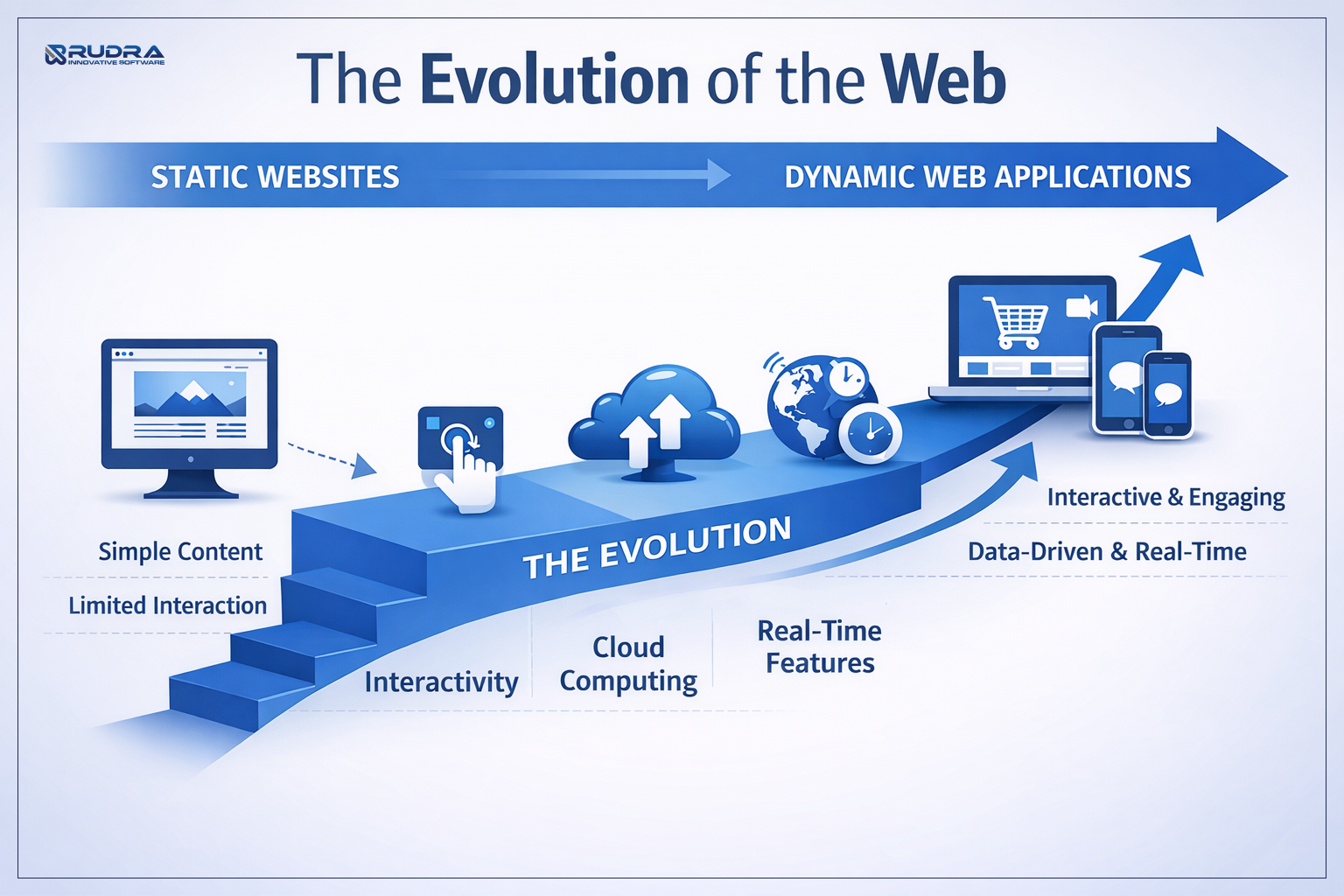
Web application development creates software solutions that operate on remote servers and deliver functionality through standard web browsers. This browser-based approach eliminates installation requirements, enabling instant access from virtually any internet-connected device a crucial advantage in our multi-device world.
The Critical Distinction: Websites vs. Web Applications
Many people conflate websites with web applications, but they serve fundamentally different purposes. Traditional websites function primarily as information delivery mechanisms. Your typical company homepage, blog, or online portfolio presents static content for consumption. Users read, view, and navigate, but don’t manipulate data or perform complex operations.
Web applications flip this paradigm. They’re interactive ecosystems where users actively engage with sophisticated functionality. Consider Gmail’s email management interface, Trello’s drag-and-drop project boards, or Salesforce’s comprehensive CRM capabilities. The defining characteristic is bidirectional interaction: applications accept user input, process that data through business logic, and deliver personalized, dynamic outputs.
Progressive Web Applications (PWAs) are blurring the line between websites and native apps, offering offline functionality and app-like experiences without app store distribution. Major brands report 50-300% increases in user engagement after PWA adoption.
Real-World Applications Across Industries
The versatility of web-based solutions makes them indispensable across virtually every sector. Sales organizations deploy Customer Relationship Management (CRM) systems to track prospects and optimize conversion funnels. Manufacturing companies implement Enterprise Resource Planning (ERP) platforms that unify financial data, supply chain logistics, and workforce management. E-commerce giants process billions in transactions through sophisticated web applications that handle inventory, payments, and logistics seamlessly.
Healthcare providers leverage patient portals for appointment scheduling, telemedicine consultations, and secure medical record access. Educational institutions deliver entire learning management systems through web applications, supporting millions of students globally. The common thread? Each application solves specific business challenges through data processing, workflow automation, and enhanced user experiences.
According to recent industry analysis, businesses implementing custom web applications report average productivity gains of 40% and operational cost reductions of 30% within the first year of deployment.
Exploring Different Web Application Categories
Selecting the appropriate application type dramatically impacts development approach, timeline, and long-term success.
Custom-Built Solutions for Unique Requirements
Custom web application development constructs purpose-built platforms tailored precisely to your operational needs. These applications address workflows, integration requirements, and business processes that generic software cannot accommodate. While demanding higher initial investment, custom development grants complete control over feature sets, data ownership, intellectual property, and future scalability paths.
Organizations choose custom development when competitive differentiation depends on proprietary functionality, when existing solutions can’t adapt to complex regulatory requirements, or when integration with legacy systems requires specialized approaches.
Enterprise-Scale Applications for Complex Organizations
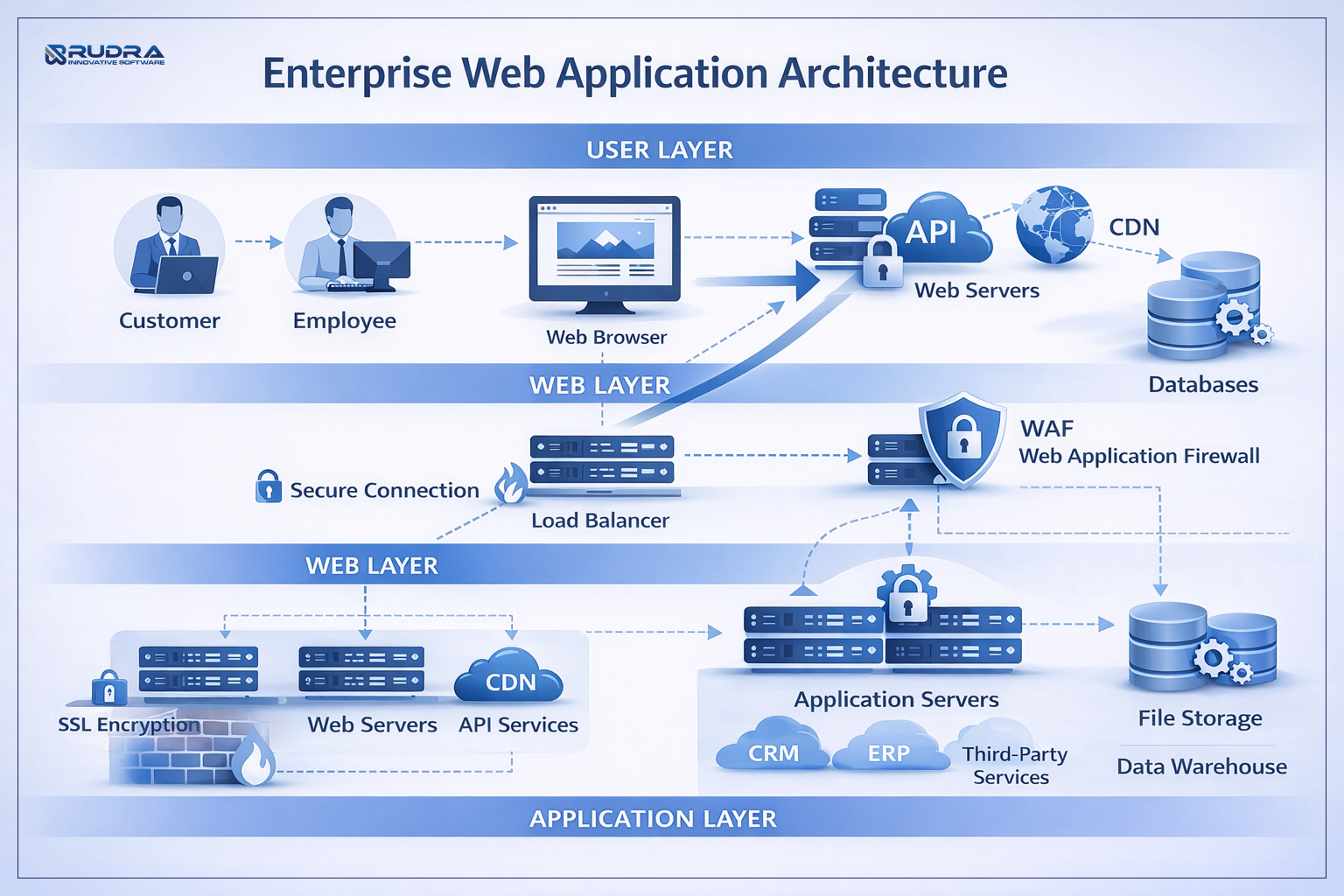
Enterprise web applications support large-scale operations spanning multiple departments, geographic regions, or even international boundaries. These platforms handle massive transaction volumes, support thousands of simultaneous users, and integrate with diverse existing systems accumulated over decades of operation.
Security, reliability, and regulatory compliance take precedence in enterprise development. Applications must maintain 99.9%+ uptime, protect sensitive data through multiple security layers, and comply with industry-specific regulations like HIPAA for healthcare or SOX for financial services.
Software-as-a-Service (SaaS) Platforms
SaaS development creates multi-tenant architectures where single applications serve numerous customers, each with isolated data and customized configurations. This model exemplified by platforms like Slack, Shopify, and HubSpot operates on subscription pricing while centralizing infrastructure management, updates, and maintenance.
SaaS architecture presents unique challenges: ensuring data isolation between tenants, supporting diverse customization needs without fragmenting the codebase, and scaling infrastructure efficiently as customer counts grow. However, successful SaaS platforms achieve impressive economics by distributing development and operational costs across expanding customer bases.
Vertical SaaS (industry-specific platforms) is experiencing explosive growth, with specialized applications for healthcare, construction, legal services, and restaurants outperforming horizontal solutions in customer acquisition and retention.
Progressive Web Applications (PWAs)
PWAs represent the convergence of web and mobile native capabilities. These applications deliver app-like experiences including offline functionality, push notifications, and device hardware access entirely through web browsers. They load quickly, work reliably on unstable networks, and install directly to device home screens without app store approval processes.
Companies adopting PWAs report significant benefits: Twitter Lite reduced data consumption by 70% while increasing pages per session by 65%. Starbucks’ PWA performs identically to their native app while requiring only 1% of the download size. For businesses seeking mobile engagement without maintaining separate iOS and Android codebases, PWAs offer compelling advantages.
The Web Application Development Lifecycle: From Concept to Launch
Professional development follows structured methodologies that transform business vision into functional software.
Phase 1: Discovery and Requirements Definition
Every successful project begins with comprehensive discovery. Development teams collaborate intensively with stakeholders to crystallize business objectives, identify target user personas, document functional requirements, and establish measurable success criteria.
This phase involves stakeholder interviews, competitive landscape analysis, user research sessions, and technical feasibility assessments. Teams document detailed user stories, create feature prioritization frameworks, and establish realistic project timelines with budget parameters.
Projects investing adequate time in discovery (typically 10-15% of total timeline) experience 60% fewer change requests and delays during development compared to projects rushing through requirements gathering.
Phase 2: UI/UX Design and Interactive Prototyping
Design transforms documented requirements into visual experiences optimizing for user satisfaction and task completion. Designers create wireframes illustrating page layouts and user journey flows, then develop high-fidelity mockups incorporating brand identity, typography systems, and visual hierarchies.
Interactive prototypes allow stakeholders to experience application flows before writing production code, dramatically reducing costly misunderstandings. Modern design processes emphasize mobile-first approaches (given mobile’s dominance in web traffic), accessibility compliance ensuring usability for all users, and intuitive navigation patterns minimizing learning curves.
Phase 3: Architecture Planning and Technology Selection
Choosing appropriate architecture patterns and technology stacks profoundly impacts performance, scalability potential, and long-term maintenance costs. Frontend decisions evaluate frameworks like React (flexibility and ecosystem), Angular (enterprise structure), or Vue.js (gentle learning curve) based on project requirements and team expertise.
Backend technology selection considers performance requirements, team capabilities, and ecosystem maturity. Options include Node.js for JavaScript-everywhere architectures, Python with Django for rapid development, or Java Spring for enterprise robustness. Database choices weigh data structure needs (relational SQL vs. flexible NoSQL), while infrastructure decisions compare cloud platforms (AWS’s breadth, Azure’s Microsoft integration, or Google Cloud’s data analytics).
Architecture patterns monolithic for simplicity, microservices for independent scaling, or serverless for operational efficiency align with organizational scale and technical capabilities.
Serverless architecture adoption has surged 200% year-over-year as businesses seek to minimize infrastructure management while optimizing costs for variable traffic patterns.
Phase 4: Parallel Frontend and Backend Development
Development typically proceeds on parallel tracks. Frontend developers construct client-side interfaces implementing responsive designs, interactive components, smooth animations, and accessibility features using HTML, CSS, and JavaScript frameworks.
Backend developers simultaneously build server-side logic, database schemas, and APIs powering application functionality. This includes implementing authentication systems, processing business logic, optimizing database operations, and integrating third-party services.
Teams following Agile methodologies work in time-boxed sprints (typically 2-4 weeks), delivering incremental functionality and incorporating stakeholder feedback continuously rather than waiting for project completion.
Phase 5: Comprehensive Testing and Quality Assurance
Rigorous testing ensures reliability before user exposure. QA teams execute multiple testing layers:
- Unit Testing: Validates individual components function correctly in isolation
- Integration Testing: Verifies system components interact properly
- End-to-End Testing: Simulates complete user workflows from login to task completion
- Performance Testing: Validates response times and stability under load
- Security Testing: Identifies vulnerabilities through penetration testing and code analysis
- Cross-Browser Compatibility: Ensures consistent experiences across browsers and devices
Automated testing frameworks enable continuous quality verification, while manual testing evaluates user experience subtleties automated tests miss.
Phase 6: Deployment and Production Launch
Deployment transitions applications from development environments to production infrastructure. Modern practices employ Continuous Integration/Continuous Deployment (CI/CD) pipelines automating testing and deployment processes, minimizing human error while accelerating release cycles.
Staged rollouts begin with beta user groups before full launches, maintaining rollback capabilities if critical issues emerge. Post-launch monitoring tracks performance metrics, error rates, and user behavior patterns, enabling rapid issue identification and resolution.
Phase 7: Ongoing Maintenance and Scaling
Successful applications require continuous attention. Regular updates address security vulnerabilities, fix bugs, and add features based on user feedback and evolving business needs. Performance monitoring identifies bottlenecks before impacting user experiences.
As user bases expand, applications require scaling vertically (upgrading server resources) or horizontally (distributing load across multiple servers). Cloud-based applications leverage auto-scaling capabilities, automatically adjusting resources to match demand patterns.
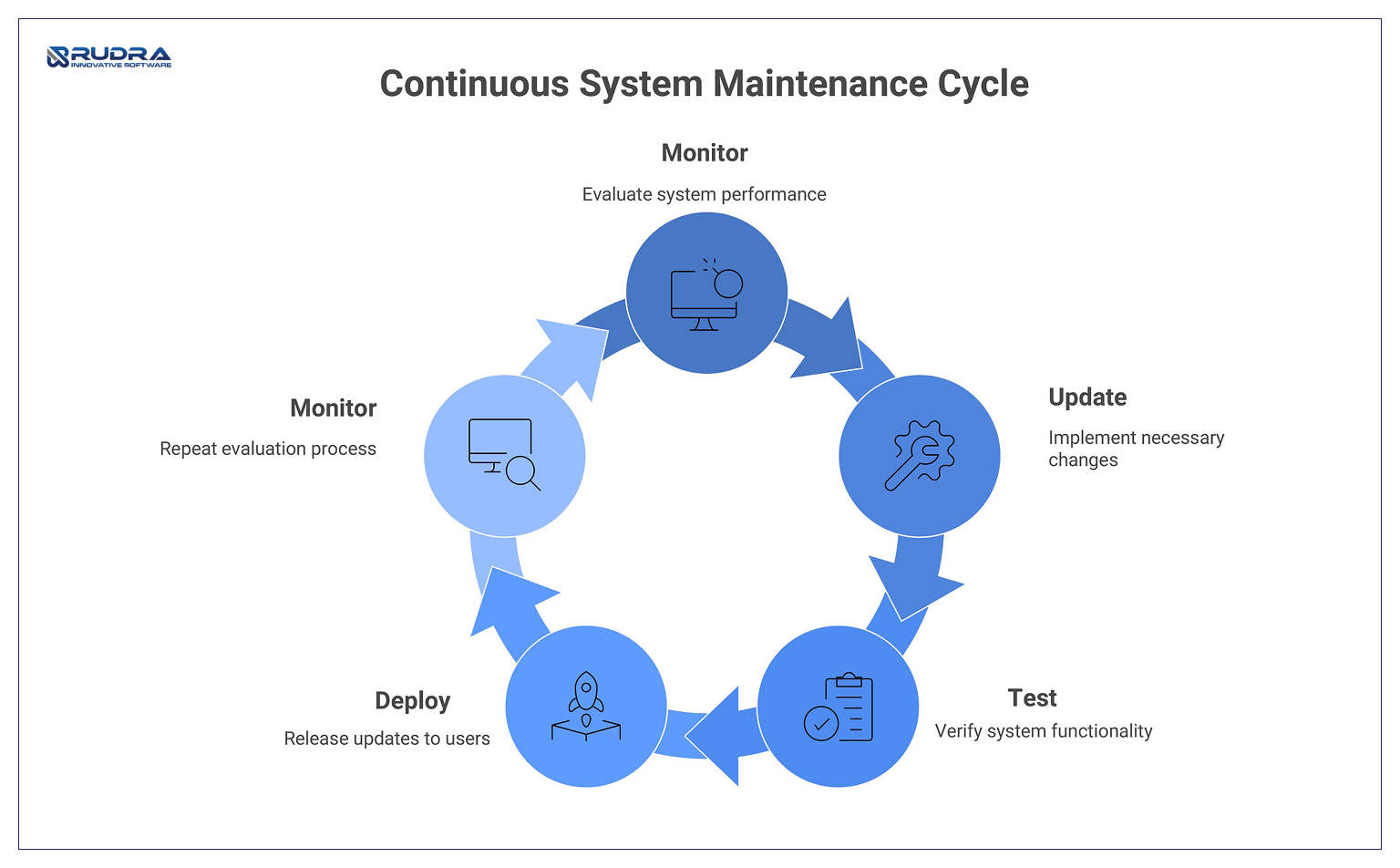
Industry research indicates that applications receiving consistent maintenance remain competitive 3-5 years longer than neglected applications, while maintenance costs typically represent 15-25% of initial development investment annually.
Understanding Web Application Development Costs in 2026
Development costs vary dramatically based on multiple interconnected factors.
Primary Cost Drivers
Application Complexity: Complexity remains the dominant cost factor. Simple CRUD (Create, Read, Update, Delete) applications with straightforward logic require fundamentally less effort than platforms incorporating machine learning, complex data visualizations, real-time collaboration features, or sophisticated workflow automation.
Feature Scope and Integrations: Each feature adds design, development, and testing hours. User authentication systems, payment processing, file management, real-time notifications, reporting dashboards, and administrative panels each demand significant effort. Third-party integrations connecting with CRM platforms, payment gateways, marketing automation tools, or legacy databases add complexity through API integration work and data synchronization logic.
Technology Stack Decisions: Technology choices impact costs through licensing fees, development velocity, and talent availability. Cutting-edge technologies may require specialists commanding premium rates. Established technologies offer larger talent pools at lower hourly rates but may sacrifice performance advantages.
Development Team Geography: Location dramatically affects rates. North American teams typically charge $100-200 hourly, Western European teams $80-150, Eastern European developers $40-80, and Asian teams $25-50. However, lower rates don’t guarantee lower total costs communication challenges, time zone friction, and quality variations can extend timelines and inflate final costs.
Hybrid development teams combining onshore project management with nearshore or offshore development talent are becoming the dominant model, balancing cost efficiency with communication effectiveness.
Realistic Cost Estimates by Application Type
Simple Applications ($15,000-$40,000): Basic platforms featuring user authentication, standard database operations, simple administration interfaces, and responsive design. Examples include portfolio platforms, appointment booking systems, or inventory trackers. Development timelines span 2-4 months with small teams utilizing established frameworks and proven patterns.
Medium Complexity Applications ($40,000-$150,000): Mid-tier platforms incorporating custom workflows, role-based permissions, API integrations, advanced search capabilities, real-time features, or payment processing. Examples include project management tools, marketplace platforms, or industry-specific business applications. These projects require 4-8 months with specialized frontend, backend, and UX designers.
Enterprise/SaaS Platforms ($150,000-$500,000+): Large-scale systems featuring extensive functionality, complex business logic, stringent security requirements, multi-tenancy architecture, advanced analytics, and infrastructure supporting thousands of concurrent users. Development spans 8-18 months with cross-functional teams including architects, senior developers, DevOps engineers, security specialists, and dedicated QA teams. Ongoing operational costs for infrastructure, maintenance, and feature development represent substantial additional investments.
Hidden costs often surprise first-time application developers. Plan for third-party service fees (APIs, cloud hosting, monitoring tools), SSL certificates, compliance audits, user training, and marketing easily adding 20-30% to development budgets.
Best Practices for Development Success
Following proven methodologies dramatically improves success probability.
Architect for Scalability from Day One
Design applications anticipating growth. Implement modular, loosely coupled components updatable independently. Consider microservices architecture for complex applications where components scale at different rates. Implement caching strategies reducing database load while improving response times. Choose cloud infrastructure supporting auto-scaling for handling traffic spikes without manual intervention.
Prioritize Security Throughout Development
Integrate security from project inception, not as afterthought. Implement robust authentication using proven frameworks rather than custom solutions. Encrypt sensitive data in transit (HTTPS/TLS) and at rest. Validate and sanitize all user inputs preventing injection attacks. Conduct regular security audits and penetration testing. Compliance with GDPR, HIPAA, or PCI-DSS requires security-first approaches from day one.
Zero-trust security architecture is becoming standard for web applications, with 78% of new enterprise applications implementing identity-based access controls and continuous authentication verification.
Embrace Agile Development Methodologies
Agile enables flexibility through iterative development cycles. Work in 2-4 week sprints delivering functional increments stakeholders can review. Maintain communication through daily standups, sprint planning, and retrospectives. Prioritize features by business value rather than building everything upfront. Agile reduces risk by validating assumptions early and adapting to changing requirements without derailing projects.
Optimize Performance Relentlessly
Users expect fast experiences slow performance directly impacts engagement and revenue. Optimize frontend through code minification, image compression, lazy loading, and efficient JavaScript execution. Reduce server response times through database optimization and caching strategies. Implement Content Delivery Networks (CDNs) serving static assets from geographically distributed servers. Monitor real-world performance and establish performance budgets preventing regression.
Plan for Long-Term Maintenance
Write clean, well-documented code future developers can understand. Establish coding standards and conduct reviews maintaining quality. Implement comprehensive logging and monitoring identifying issues quickly. Plan regular dependency updates addressing security vulnerabilities. Budget for feature enhancements based on user feedback and evolving needs.
Navigating Common Development Challenges
Understanding typical obstacles enables preventive measures.
Controlling Scope Creep
Scope creep occurs when requirements expand beyond original plans without corresponding timeline or budget adjustments. Prevent through detailed initial documentation, formal change request processes, and regular stakeholder communication about trade-offs between scope, schedule, and budget.
Ensuring Requirement Clarity
Vague requirements lead to misunderstandings, rework, and dissatisfaction. Mitigate through thorough discovery phases, detailed user stories with acceptance criteria, and interactive prototypes validating understanding.
Preventing Performance Bottlenecks
Performance issues often emerge only after launch. Address through performance testing during development, code profiling identifying slow components, and load testing simulating peak traffic.
Addressing Security Vulnerabilities
Security weaknesses expose applications to attacks, causing data breaches and reputation damage. Prevent through security-aware development training, focused code reviews, automated vulnerability scanning, and following OWASP guidelines.
Selecting the Right Development Partner
Choose partners carefully this decision dramatically impacts success.
Evaluate Experience and Portfolio – Review previous projects, particularly those in your industry or with similar technical requirements. Examine case studies for problem-solving evidence and delivered results. Contact client references learning about actual working experiences.
Assess Technology Expertise – Ensure teams demonstrate deep knowledge of required technologies. Evaluate experience with relevant frameworks, platforms, databases, and integration patterns. Strong technical teams explain architectural decisions clearly and demonstrate understanding of trade-offs.
Prioritize Communication and Transparency – Effective communication prevents misunderstandings. Evaluate responsiveness during initial conversations. Discuss project management approaches, reporting cadences, and stakeholder involvement expectations. Transparent teams provide realistic timelines and honest challenge assessments.
Confirm Post-Launch Support – Clarify post-launch support arrangements before contracts. Understand response time commitments, change request processes, and support level costs. Companies offering comprehensive maintenance demonstrate commitment to long-term partnership.
Conclusion: Building for Long-Term Success
Web application development represents strategic investment transforming operations, enhancing experiences, and creating competitive advantages. Success requires understanding the complete lifecycle, from discovery through ongoing maintenance.
While costs vary based on complexity, features, and team expertise, investing in quality development, scalable architecture, and robust security delivers superior long-term value compared to short-term cost-cutting. Applications built on solid foundations adapt to changing needs, scale efficiently, and remain secure against evolving threats.
The most successful projects share common characteristics: clear upfront requirements, experienced teams with relevant expertise, regular stakeholder communication, comprehensive pre-launch testing, and commitment to ongoing improvement. As businesses increasingly rely on digital tools, organizations investing thoughtfully in web application development position themselves to thrive in our digital economy.