The grocery delivery sector in India has entered a new phase defined by speed, and Zepto is one of the strongest names leading this transformation.
While many players still talk in terms of 30–40 minutes, Zepto shifted the benchmark to a matter of minutes.
Built on a network of dark stores, AI-powered logistics, and an aggressive quick-commerce strategy, Zepto has reimagined how urban consumers purchase everyday essentials.
This blog explains:
- What Zepto is
- How Zepto’s business model works
- How Zepto earns revenue
Its competitive positioning and future outlook
What is Zepto?
Zepto is a quick-commerce startup founded in 2021 by Aadit Palicha and Kaivalya Vohra. The company became popular for promising 10-minute grocery delivery through its network of dark stores and optimized last-mile delivery.
Zepto operates its own micro-fulfilment centers, which helps it:
- maintain product quality
- control inventory in real time
- deliver faster
- manage pricing strategically
Customers can order groceries, snacks, beverages, and daily essentials through the Zepto mobile app, track orders live, and pay securely.
Zepto primarily competes with:
- Blinkit
- Swiggy Instamart
- BigBasket
and continues to expand using AI, automation, and private-label products.
How Zepto’s Business Model Works
Zepto follows an inventory-led quick-commerce model rather than acting purely as a marketplace.
Instead of depending on partner stores, Zepto stocks products in its own dark stores, located within a 2–3 km radius of customers. This gives it full control over:
- inventory
- pricing
- delivery time
- order accuracy
Step-by-step Zepto order process
- Customer places an order- Items are selected through the app and routed to the closest dark store.
- Inventory verification & picking – AI forecasts ensure products are already stocked. Orders are picked and packed usually within a minute.
- Automatic rider assignment – The nearest delivery partner is selected using route optimization and live traffic analysis.
- Last-mile delivery – Orders are delivered within minutes through hyperlocal riders.
- Continuous learning – Every order feeds data into Zepto’s AI engine, refining demand forecasts and delivery efficiency.
This model enables Zepto to maintain high speed, consistency, and customer satisfaction.
Zepto Business Model Canvas
Key Partners
- FMCG suppliers and brands
- Delivery partners
- Technology and cloud solution providers
- Real estate and warehouse partners
- Investors and funding partners
Key Activities
- Operating dark stores & fulfilment centers
- Demand forecasting and inventory planning
- Technology development and app maintenance
- Marketing, retention, and customer engagement
Key Resources
- AI & data analytics systems
- Zepto mobile app & backend infrastructure
- Dark store network
- Skilled logistics and operations team
Value Proposition
- Ultra-fast delivery
- Affordable pricing
- Reliable order fulfilment
- Growth opportunities for franchise and supply partners
Customer Segments
- Urban professionals
- Students
- Families in metro & Tier-1 cities
- Franchise & warehouse partners
Customer Relationships
- Membership programs like Zepto Pass
- Personalized recommendations
- 24/7 chat support
Channels
- Zepto mobile app
- Website
- Digital marketing, influencer collaborations, referrals
Cost Structure
- Logistics and delivery
- Technology investment
- Warehouse rent and employee salaries
- Marketing and promotions
Revenue Streams
- Product margins
- Delivery fees
- Subscriptions
- Advertising & sponsored listings
- Private-label products
Zepto Revenue Model: How Zepto Makes Money
1. Product Margins – Zepto controls its inventory, allowing bulk procurement and better margins than pure marketplaces.
2. Delivery & Platform Fees – Customers are charged delivery or convenience fees depending on:
- cart value
- peak demand
- distance
3. Subscription Programs (Zepto Pass)
Memberships provide:
- free delivery
- exclusive discounts
- early access to offers
in exchange for recurring monthly revenue.
4. Advertising & Retail Media
- Brands pay Zepto for:
- promoted listings
- digital ad placement
- in-app brand visibility
5. Private Labels & Zepto Café
Zepto earns higher margins via:
- in-house grocery brands
- ready-to-eat snacks and beverages
Competitor Comparison: Zepto vs Other Quick-Commerce Players
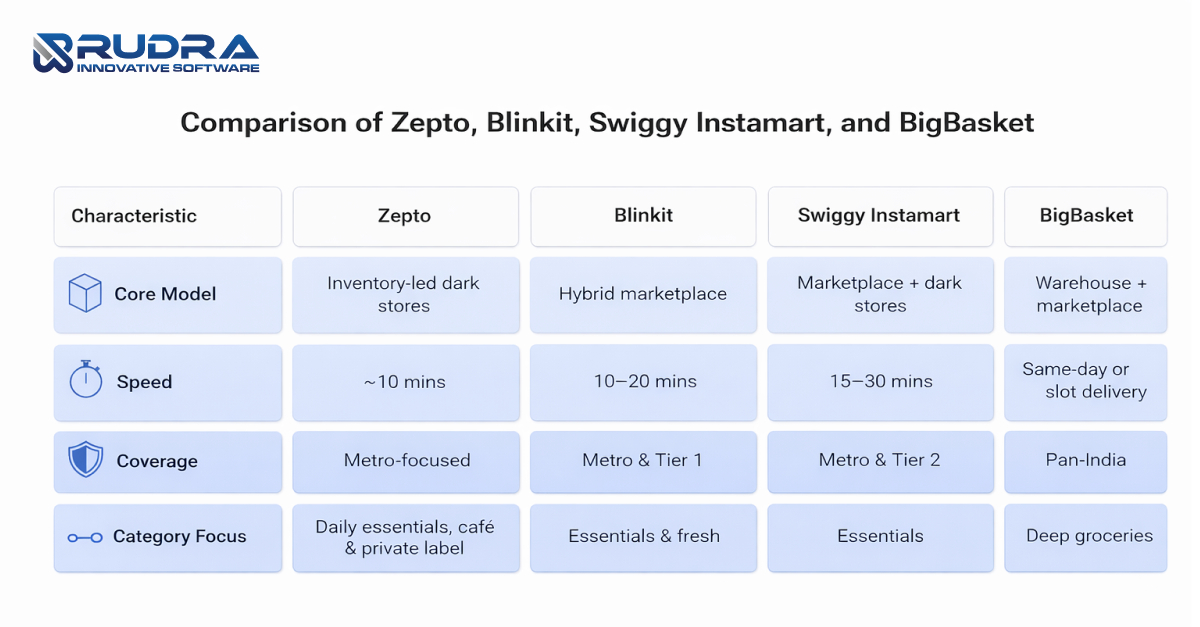
What sets Zepto apart
- heavily optimized delivery radius
- strong AI-driven logistics
- fully controlled inventory
- focus on instant top-up purchases
SWOT Analysis
Strengths
- fastest delivery promise
- strong technology backbone
- high brand recall
Weaknesses
- thin margins
- limited non-metro reach
Opportunities
- Tier-2 expansion
- franchise dark-store model
- retail media growth
Threats
- regulatory pressure
- competition pricing wars
Future Outlook: What Lies Ahead for Zepto
Zepto is expected to:
- expand private-label offerings
- strengthen AI-based personalization
- grow dark store franchise programs
- increase focus on profitability metrics
The company is moving beyond groceries into snacks, beverages, and café-style offerings, while doubling down on membership-led loyalty.
Conclusion
Zepto has transformed India’s quick-commerce ecosystem by proving that speed, technology, and customer loyalty can coexist.
Its model of:
- AI-led operations
- hyperlocal dark stores
- subscription revenue
- private labels
- positions it strongly for future growth.
Businesses planning to build similar platforms can learn from Zepto’s approach—tight supply chain control, data-first decisions, and user-focused design.
FAQs (Frequently Asked Questions )
How is Zepto different from other grocery delivery apps?
Unlike marketplace-based platforms, Zepto follows an inventory-led model where it owns and operates its own dark stores. This gives Zepto direct control over product quality, pricing, inventory management, and delivery times, enabling consistently faster service than competitor models.
Does Zepto own its inventory or act as a marketplace?
Zepto owns and manages its inventory through company-operated dark stores. This inventory-led approach differs from pure marketplace models and allows for better quality control, dynamic pricing strategies, and optimized stock management based on real-time demand.
Who are Zepto’s main competitors?
Zepto competes primarily with Blinkit (formerly Grofers), Swiggy Instamart, and BigBasket in the quick-commerce space. Each platform competes on delivery speed, pricing, product selection, and service quality.
What technology does Zepto use?
Zepto leverages AI and machine learning for demand forecasting, inventory optimization, automatic rider assignment, and route planning. The platform uses data analytics to predict purchasing patterns, optimize stock levels, and continuously improve delivery efficiency.